

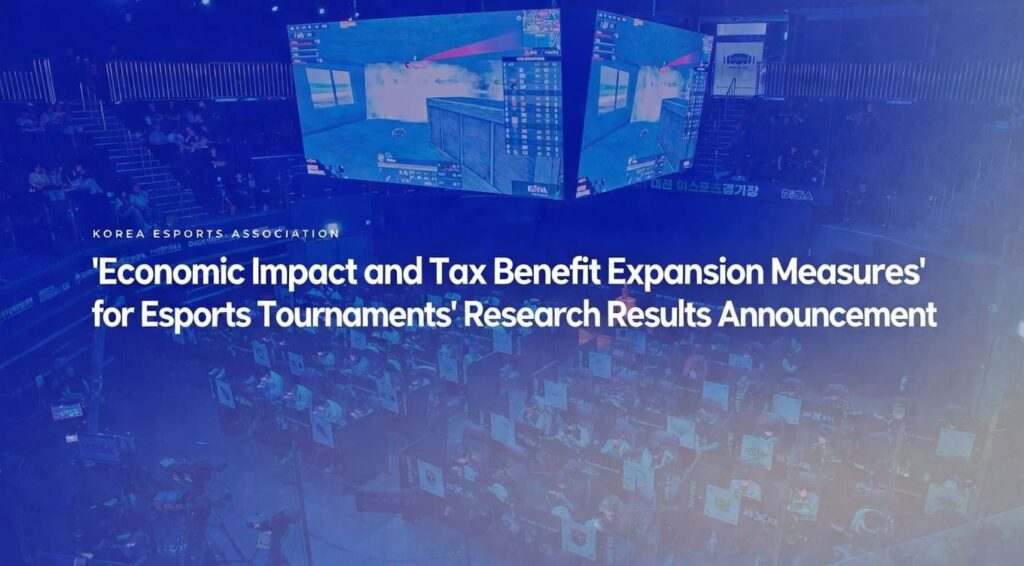


South Korea is considering expanding tax benefits for the esports industry, following a new policy study released by the Korea e-Sports Association (KeSPA).
The report, titled “Research on the Economic Effects of Esports Tournaments and Measures to Expand Tax Benefits,” says esports has grown into a full industry with teams, players, sponsors, media companies and fans. However, it argues that current laws and tax policies do not fully reflect this change.
At present, there are two main tax benefits for esports companies:
- Companies that hold esports tournaments outside the Seoul metropolitan area can receive a 10 percent corporate tax credit on certain operating costs. These include prize money, venue rental and equipment rental.
- Companies that run officially designated esports teams can also receive a 10 percent corporate tax deduction on team operating costs, such as player salaries and training expenses.
However, the report points out several limits. The regional tournament tax credit only applies outside the capital region and is temporary. It is set to expire at the end of December 2026, and the actual application period is relatively short.
The support for team operations is also limited in duration, especially for newly established teams, which may receive benefits for only three years. The study says many esports teams are in chronic financial difficulty. Player salaries have risen sharply and often make up more than 70 percent of a team’s costs. At the same time, most team revenue still comes from sponsorship deals.
Because of this structure, teams can lose more money as they try to grow. The report says stronger and longer-lasting tax support could help improve financial stability.

The study recommends several changes, including:
- Removing the expiration date on regional tournament tax credits.
- Raising the tax credit rate from 10 percent to between 15 and 20 percent.
- Extending and strengthening tax benefits for team operating costs.
- Introducing new tax incentives for building esports facilities such as arenas.
- Expanding tax support for research and development related to domestic esports titles and technology.
The report also stresses that the esports industry remains heavily dependent on game publishers that own the intellectual property of each title. This “IP dependency” can create uncertainty for teams and investors, as major decisions about leagues and rules are controlled by the publisher.
To counter this dependence, KeSPA suggests an “unbundling” model. Under this system, the game publisher would provide the IP license, while league planning, operations and commercial activities would be handled more independently by a separate operating body.
It also recommends requiring long term agreements, lasting five to ten years, between publishers and league operators. This is meant to prevent sudden league cancellations or major changes that could harm teams and investors.
The proposal to form a standing consultative body involving publishers, leagues, teams and the association has also been discussed. This group would regularly discuss important matters such as league schedules and game updates, instead of leaving decisions entirely to publishers.
The report itself runs more than 150 pages and covers a wide range of other ideas, from player protection and standard contracts to regional development and new investment support measures. It is not possible to go through every recommendation in one article.
But the main takeaway is simple. The study suggests treating esports as a serious, long-term industry and updating policies to reflect how large and complex it has become. What happens next will likely reshape how South Korea’s esports scene develops in the years ahead.
Follow The Esports Radar on social media: