

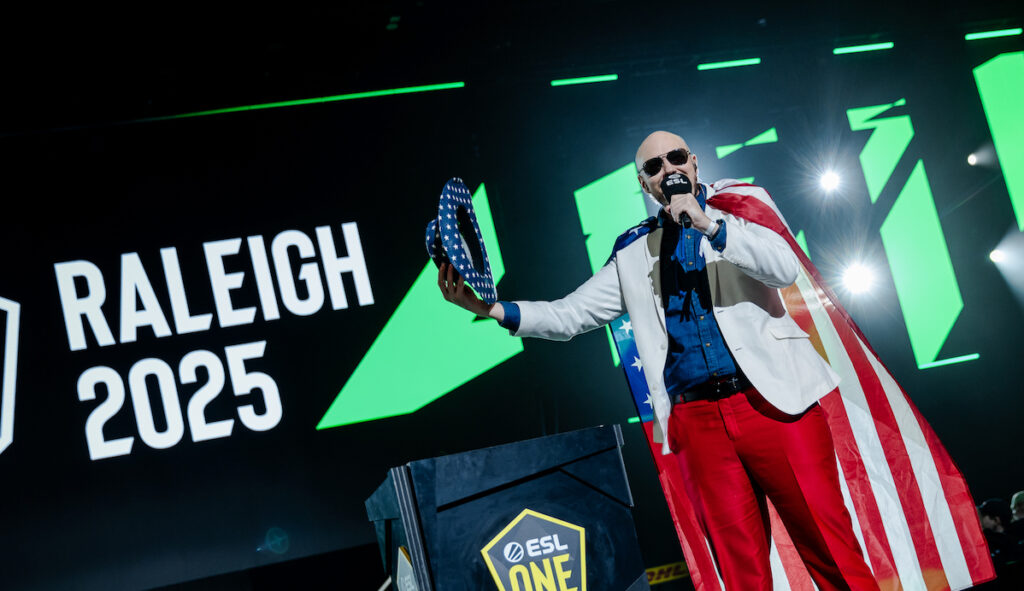


Guest post by Loren Gold and Ed Tomasi from Visit Raleigh.
The global esports industry is entering its most ambitious chapter yet: the era of nation-versus-nation competition. With the launch of the biennial Esports Nations Cup (ENC) and the momentum behind the Olympic Esports Games (OEG), a new layer of national pride and structured governance is transforming the landscape of competitive gaming.
These multi-title, multi-country spectacles are shifting the focus from club-based leagues to national teams, mirroring the patriotic fervor of the traditional Olympics or World Cup. But for the United States to field a gold-medal-caliber team—and for these global initiatives to succeed—they need partners with proven infrastructure, deep industry ties, and an authentic commitment to the gaming ecosystem.
The greatest immediate opportunity may not be in hosting the Finals, but in establishing best-in-class National and Regional Qualifier events.
For destination marketing organisations (DMOs) and local organising committees, securing these critical qualification gateways is the new competitive frontier. At the Greater Raleigh Esports Local Organizing Committee (GRELOC) and Visit Raleigh, we believe hosting successful National Qualifiers requires moving beyond simply having a large convention center. It demands a holistic commitment across three key pillars.
Insights from industry leaders are clear: the path to securing these national qualifying events is a strategic one, not merely a procurement process. As recently highlighted during the Esports Leaders London 2025 roundtable, which Visit Raleigh proudly moderated, success in this “nation vs. nation” format hinges on a commitment that is publisher-driven, politically supported, and community-connected.
The consensus holds that the Esports Nations Cup will establish the functional blueprint for qualification before the Olympic Esports Games finalizes its processes. Therefore, the immediate focus must be on meeting the demands of this emerging model.
Securing a National Qualifier means securing the right game titles. The roundtable emphasized a shift to directly engaging publishers based on regional popularity. For Raleigh this means that we must immediately identify a select list of game titles that are most popular in the North American region, and develop initiatives directly with the publisher(s), specifically targeting genres relevant to the ENC/OEG format, such as those from Riot Games (including their new fighting game) and titles like baseball simulations from Konami. Our location, minutes from Epic Games and other major tech hubs, uniquely positions us to execute these direct, co-branded partnerships.
Hosting national qualifiers for events like the ENC and OEG is intrinsically a matter of national prestige. Organisers will favour destinations that demonstrate governmental and corporate alignment, ensuring stability and a sense of national identification.
The success of a host destination, especially in the US, will be tied to national/federal recognition of esports and the associated funding and support. We’ve always taken the approach of Think Global – Play Local, and as the capital of North Carolina, our strategy has involved educating local and state government to garner their overt support. This concerted effort is exemplified by the existing North Carolina Esports Industry Grant, which provides a 25% rebate on qualifying expenses—a concrete sign of political backing and economic stability.
A host destination must also project an ability to handle high-profile international travel. We are actively working to project esports as a sense of national identification to state and federal stakeholders, which includes advocating for favorable esports Visa treatment/application processes to ensure smooth entry for all participating regional or international athletes and staff. The political relationship/climate is a key vetting criterion for event producers and rights holders, and Raleigh’s cooperative, business-friendly environment is a powerful asset we are sure to present.
Global organising bodies need to see deep financial and logistical commitment from local brands. To address this, we would look to approach the ENC and OEG not with a simple bid, but with a confirmed investment group model. We are actively identifying committed regional brands to support qualification events through sponsorship commitments, and may look to start this engagement at the Memorandum of Understanding (MOU) level. Our list of potential supporters includes global heavyweights already present in our area, such as Lenovo, SAS Institute, IBM, Cisco, Delta Air Lines, Red Hat, Meta, Apple, NVIDIA and Google Fiber. This demonstrates a potentially deep, cross-industry financial partnership that could significantly lower the risks of producing the event for the global organisers.
We recognize that national qualifiers are complex, multi-game events that require more than just an arena; they need flexible event producers, multifaceted infrastructure, and a focus on the player/fan experience. So we have identified trusted regional esports event partners and facilities (e.g., educational institutions like NC State University, William Peace University and Wake Tech Community College, Raleigh Convention Center, Lenovo Center, etc.) to help champion our destination. These partners will co-present with Visit Raleigh to the ENC and OEG, ensuring trust and expertise is embedded in our pitch. Furthermore, we are open to working with other like-minded, trusted destinations to co-present through alliances.
We continually look to highlight our local facilities and infrastructure, including the planned modernization of the Lenovo Center entertainment complex and the expansion of our downtown Raleigh Convention Center. We are actively engaging with local/regional commercial real estate developers to garner their support in hosting and enhancing the tournament/festival experience for esports players and fans. In addition, we are developing and highlighting dedicated “esports tourism” programs and experiences for players (and fans). This ensures that the time spent in Raleigh is not just a competition, but a holistic, memorable experience that reflects our community’s genuine, long-term commitment to elevating esports.
The fact remains that no one city can be the “global capital of esports”, but we never take for granted the fact that Raleigh must always look to learn and advance, transform in some cases, from the proven host destination it is today, into the undisputed National Qualifier Gateway for the next generation of global, nation-versus-nation esports.
Follow The Esports Radar on social media: