

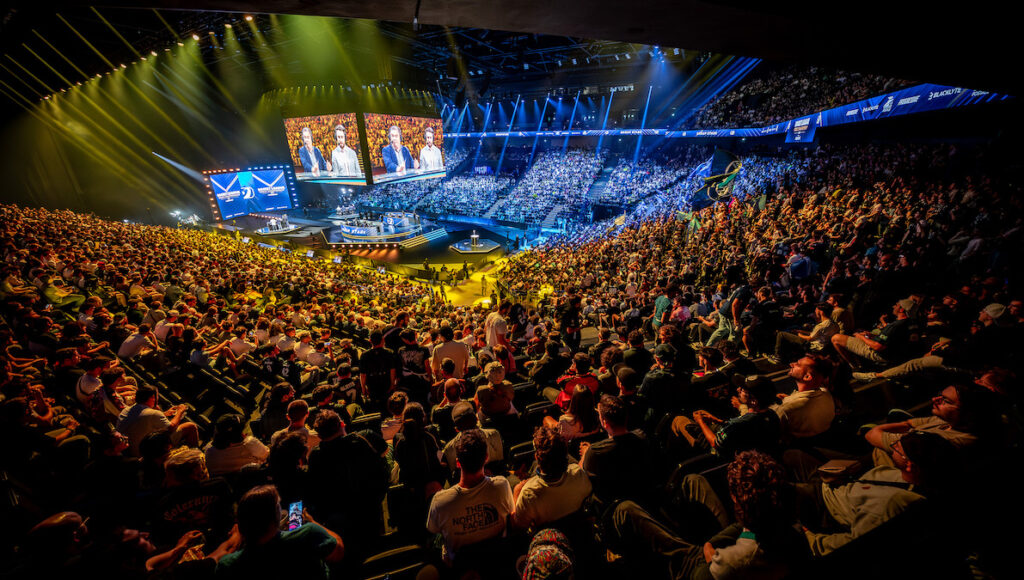


The year 2025 will be remembered as a pivotal period of reckoning and realignment for the global esports industry. It was a year characterised by stark contradictions: historic financial investments collided with high-profile corporate collapses, while transformative regulatory changes reshaped the commercial landscape.
From seismic shifts in sponsorship rules to painful industry corrections and breathtaking viewership milestones, the following twelve headlines capture the essential forces that defined a year of profound transition, laying a new and more challenging foundation for the future of competitive gaming.

1 – Valve Bans Skin Trading and Gambling Sponsorships from Tournaments
Valve enacted a strict new rule prohibiting the promotion of skin gambling, case-opening, and trading websites at any officially licensed tournament for its games. This instantly severed a major revenue stream for countless teams and event organisers, disproportionately impacting smaller entities that relied heavily on such sponsors and challenging a rapid, industry-wide search for alternative funding.
2 – Riot Games Opens Doors to Regulated Betting Sponsorships
In a major policy reversal, Riot Games announced it would allow Tier 1 teams in its League of Legends and VALORANT leagues to partner with approved betting companies. This move, aimed at controlling integrity and generating ecosystem revenue, created a new, controversial sponsorship category while imposing strict conditions like mandatory integrity programs and a ban on jersey logos during official broadcasts.
3 – Electronic Arts Acquired in Historic $55 Billion Deal
Gaming giant EA was purchased by a consortium including Saudi Arabia’s Public Investment Fund (PIF) in the largest all-cash sponsor take-private deal in history. This acquisition profoundly consolidated influence over major esports titles like Apex Legends and EA FC under Saudi strategic interests, further intertwining the futures of global gaming and esports with the kingdom’s investment vehicles.
4 – Guild Esports Collapses, Leaving Trail of Debt
The once-high-flying, publicly-listed UK organisation Guild Esports entered liquidation. Its closure revealed reportedly over £2.3 million in unpaid debts to staff, creators, and partners, serving as the year’s most stark cautionary tale about unsustainable spending and alleged mismanagement.
5 – Esports World Cup Foundation Launches the Esports Nations Cup
Saudi Arabia’s Esports World Cup Foundation announced the Esports Nations Cup, a biennial global tournament where players represent their countries. Developed with major publishers and featuring a rotating host model, this initiative positions the EWCF to create its own legacy of national team competition, directly shaping a new frontier in international esports alongside—or in competition with—the stalled Olympic project from the IOC.
6 – IOC and Saudi Arabia Split on Olympic Esports Games
The International Olympic Committee and its Saudi partners terminated their collaboration to host the Olympic Esports Games. This mutual split leaves the IOC the option to explore a new model for the event, while Saudi entities focus on their own portfolio (Esports World Cup, Nations Cup), signaling a fragmentation in the pursuit of esports’ premier “Olympic-style” global event.
7 – BLAST Austin Major Breaks Counter-Strike Viewership Record
The BLAST Austin Major 2025 became the most-watched tournament in Counter-Strike history, with over 76 million hours watched. This record demonstrated the enduring, peak viewership power of top-tier CS2 competition and the massive global audience it commands, even amidst a year of industry turmoil.
8 – Honor of Kings Finals Set New Live Attendance World Record
A mobile esports event, the Honor of Kings KPL Grand Finals, set a new Guinness World Record by packing over 62,000 fans into Beijing’s Bird’s Nest stadium. This milestone powerfully validated the massive scale and fan passion of mobile esports, rivaling or surpassing traditional PC-based events in live spectacle.
9 – LCS & CBLOL to Revert to Independent Leagues in 2026
Riot Games announced the end of its combined League of the Americas experiment after one year, stating the LCS (North America) and CBLOL (Brazil) would return as fully separate leagues in 2026. This was a direct response to fan feedback, underscoring that regional identity and legacy rivalries are more powerful drivers of engagement than forced cross-regional play.
10 – Germany Grants Esports Non-Profit Status
The German Bundestag voted to recognise esports as a non-profit activity, granting clubs significant tax exemptions and access to grants. This legislative move provided a framework for greater financial stability and institutional legitimacy for grassroots and club-based esports development in a major European market.
11 – India Bans Real-Money Gaming, Formally Recognises Esports
India’s parliament passed a landmark bill that instituted a nationwide ban on real-money gaming while simultaneously granting formal recognition to esports as a sport. This dual-action legislation created a clear, state-sanctioned distinction between gambling and competitive gaming, promising government support for esports development while destabilizing a large segment of the country’s existing gaming economy.
12 – UK Student Esports Consolidated with NSE Acquisition
The UK’s National Student Esports (NSE) was acquired by the Esports Global fund and placed under the operation of the British Esports Federation. This acquisition unified the country’s major university and school-age competitive pathways, signaling a move toward centralised development and governance in the vital grassroots and educational sector of the industry.
Follow The Esports Radar on social media: