


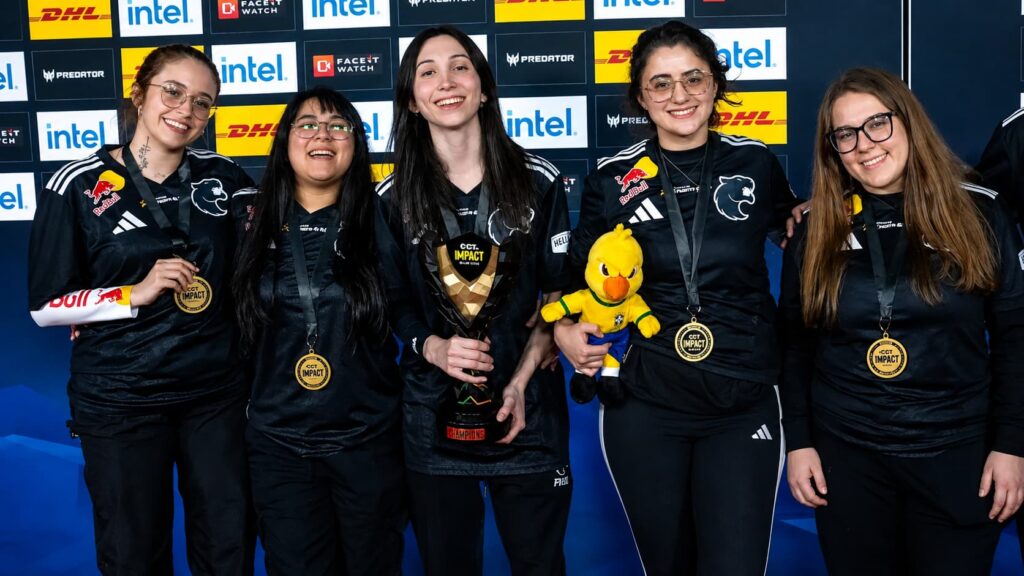


Brazilian esports organisation FURIA has moved its entire women’s Counter-Strike 2 (CS2) roster over to VALORANT.
As per the official announcement, the same five players who competed together in CS2 are now training and preparing to compete under FURIA’s banner in VALORANT’s Game Changers circuit, the game’s official competition track for women and gender-diverse players.
FURIA’s latest move is less about VALORANT’s appeal and more about what’s left of women’s CS2 competitive scene. Women’s CS2 has been struggling for a while, and the situation got worse at the end of 2025 when ESL Impact, which was the main global tournament series for women’s Counter-Strike, shut down indefinitely. The organisers said that the business behind it wasn’t sustainable.
From a business perspective, Counter-Strike’s women’s scene relied heavily on third-party organisers like ESL FACEIT Group (EFG) to fund and run its main events. When that funding stopped making sense for EFG, the entire circuit disappeared with it. With that gone, the number of high-level tournaments for women’s CS2 shrank sharply, leaving teams with very few places to actually play and be seen.
VALORANT’s women’s competitive scene, on the other hand, isn’t run by outside tournament organisers that need their own sponsors and funding to keep events alive. Riot Games, which makes VALORANT, runs it directly as an official part of the game.

That has a few practical effects. First of all, players know well in advance when and where they’ll be competing, with year-round tournaments building toward VCT Game Changers. Riot also pays prize money and funds events directly which makes larger organisations more willing to pay players a steady salary and reduces the risk of tournaments being cancelled at the last minute.
FURIA’s exit from the women’s CS2 competitive scene isn’t an isolated case. Other well-known women’s Counter Strike players have made the same jump recently, including Mayline “ASTRA“ Champliaud, who was named HLTV’s Women’s Player of the Year for 2025. Finnish Counter-Strike 2 player Alessandra “amy” Kolari also shifted to VALORANT this year, stating that after Impact shut down, she doesn’t see a reason to compete without a consistent circuit and support.
However, the decline of women’s CS2 has not gone completely unchallenged. Organisations like Brace 4 Impact partnered with ESL FACEIT Group this year to organise inclusive tournaments for women and marginalised genders. In Brazil, FERJEE (Rio de Janeiro State Federation of Electronic Sports) organised Rainhas do Clutch, a women’s Counter-Strike tournament series to keep the scene active.
While these initiatives have provided important opportunities, they have seemingly not been enough to replace the consistent, sustainable competition that ESL Impact once provided.