



Traditional sports and esports are often seen as competing industries due to a set of factors spanning from cultural differences to their efforts to attract sometimes the very same eyeballs – or sponsors – that would support one or another. With their strong offline presence and long club histories, traditional sports have a typically conservative image. Esports are seen as belonging to the digital sphere, thanks to their strong online presence and gaming culture, often framed as a way to connect with a younger audience.
The reality, however, is more interesting and multi-faceted: sports and esports interact, learn from each other, and give rise to new concepts at the intersection of the two industries. They are both part of a single, dynamic entertainment ecosystem, where it’s not only the boundaries between industries that are broken down, but the boundaries between fans, too.
Consumer culture is changing, and this is the natural result. GG.BET, a top esports bookmaker which works to develop sport on local markets and establish innovative projects at this intersection, is here to share its observations and provide examples of how the lines between esports and sports are becoming blurred.
The power of best practices: transformation through shared experience
Despite their different backgrounds, match dynamics, and presentation in popular culture, esports and sports have a lot in common. Each sports and esports discipline has its own ecosystem with its own tournaments and leagues, and its own approach to competitions, rules, working with partners, and interacting with fans. But as a result of the different ways in which these industries have developed, each has strengths from which the other can benefit.
The impact of esports: the power of streaming, interactivity, and operating live
Esports are far from being a 100% digital product. The industry has its roots in local computer clubs which started up in the pre-internet era. LAN tournaments which draw in fans from all over the world are every bit as spectacular as sports matches in a stadium. But what has always set esports apart is multi-level online streams and a focus on interactivity and engaging with viewers. Highlights and key game statistics in live mode, custom graphics, alternative broadcasts on streaming platforms, and gamification are all part of what forms the basis of esports broadcasts – and it’s these elements that are being carried over into the traditional sporting arena.
For example, star-studded football matches are now frequently accompanied by alternative broadcasts hosted by streamers and celebrities. This happens courtesy of the leagues, and also as a collaboration between “market players” and influencers. The National Football League (NFL) have brought in their own alternative broadcasts with media and gaming personalities: ManningCast with Peyton and Eli Manning on ESPN2 and ESPN+, and coverage of the Wild Card and special events on Nickelodeon featuring Spongebob, Patrick Star, and others.
The gamification of broadcasts is now a feature of the NFL: for instance, during the Cincinnati Bengals and Dallas Cowboys match, players turned into characters from The Simpsons, and coverage of the match between the Atlanta Falcons and Jacksonville Jaguars was delivered in Toy Story style (the pitch was located in a cartoon character’s bedroom, the players were animated live, and the stadium was stylized to resemble a toy world).
Matches like these take on the appearance of a video game and turn the event into a show. On local markets, alternative broadcasts of football matches are now frequently run by bookmakers operating as team or league partners. These are usually all about humor, chatting with viewers, and the involvement of sports stars and media personalities. The viewers themselves often receive additional perks in the form of opportunities to take part in prize draws.
One of the most exciting examples of how live game statistics are being integrated into traditional sports and how watching sports events is becoming more interactive is the broadcast of the Olympic Games. Take figure skating as an example. At the 2026 Winter Olympics in Milan, during the skaters’ performances, statistics showing how successfully they performed a given element were displayed on the screen, points for each element performed were tracked live, and after the performance, the trajectory of top jumps and performance highlights were shown. All this ensures the viewer doesn’t miss any key moments and understands how the performance is rated from a technical perspective.
In fact, traditional sport is now gradually integrating something the esports world has been honing for years: more interactive engagement with fans in various formats (alternative broadcasts, detailed breakdowns of official broadcasts, etc.).
The impact of sports: the structure of the industry, approach to media presence, and talent development
The esports ecosystem developed significantly later than that of traditional sports, and this comes with its advantages. Firstly, traditional sports have demonstrated the inner workings of a sports-based industry – how tournaments and leagues are organised, how tournament brackets are drawn up, how the transfer market operates, the partnerships that emerge, and so on. The best practices sport could provide at this stage are examples of established systems in various types of sport.
Despite the fact that esports has its own approach to organizing and hosting tournaments, its own rules and requirements, and that its competitions are based in a virtual rather than physical space, its structure has elements of the classic sports approach. The most obvious is the structure of the teams themselves: players, coaches, analysts, c-level, etc. Like sports, esports also has an established training system – both physical and within the game – owing to the specific features of the industry. Preparation for new gaming seasons and specific tournaments, team boot camps, review of gaming strategies, and match analysis are all key to an esports team’s performance.
Like traditional sports, esports has star players with huge fan bases and a cultivated personal brand. Sports laid the foundations for this phenomenon by creating the conditions in which talented players can become public figures, sign personal contracts worth millions with brands, and influence the transfer market. In the foreseeable future, famous esports players will be no less influential in popular culture than the legendary footballers or basketball players. An example is the status the League of Legends star Lee “Faker“ Sang-hyeok has achieved.
Some key ideas borrowed from sport are scouting and the development of talent via team academies. Dreaming that the game could become more than just a hobby and your talent could be discovered has always been part of sports culture, and this is mirrored in esports. One example is NAVI’s academy for young talents. Key strategic roles in this esports organisation are occupied by former pro players who pioneered the development of Ukrainian esports and are living proof that dreams really do come true.
Providing a pathway to professional growth is a sports tactic which has been reimagined by esports to suit its own circumstances.
Cross-industry projects: how sports and esports collaboration strengthens both
Cross-functional projects are the result of strategic decisions, crazy ideas, brainstorming, and experiments being put into action. One of the key steps here is the involvement of sports teams, and even entire leagues, in esports. EA Sports, for example, foments the integration of traditional clubs through their $1 million EA FC circuit, which resulted in partnerships such as Team Liquid with Sunderland AFC and Evil Geniuses with Austin FC.
And we are not only speaking of football-themed games. FIFA even integrated Rocket League in its FIFAe initiative, while PSG, Barcelona, Manchester City and other football teams now have a track record in different esports disciplines or gaming simulators. Also, star footballers became investors or have even founded their own esports organisations like Sergio Agüero (KRÜ Esports) and Oleksandr Zinchenko (Passion UA).
Parallel to this, we’ve begun to see projects that bring together the best aspects of sports and esports. Among these is the Kings League, Gerard Piqué’s football league with virtual “Secret Cards” which can change the course of a match, and the ability for fans to vote on the introduction of new rules. The league even counts on esports organisations and personalities fielding teams around the world, like G2 in Germany and paiN Gaming in Brazil.
Other examples include the NBA 2K League (an esports league from the National Basketball Association in which teams represent franchised basketball clubs), F1 Esports Series (a series of tournaments from Formula 1 in which official squads field their own esports teams), and more.
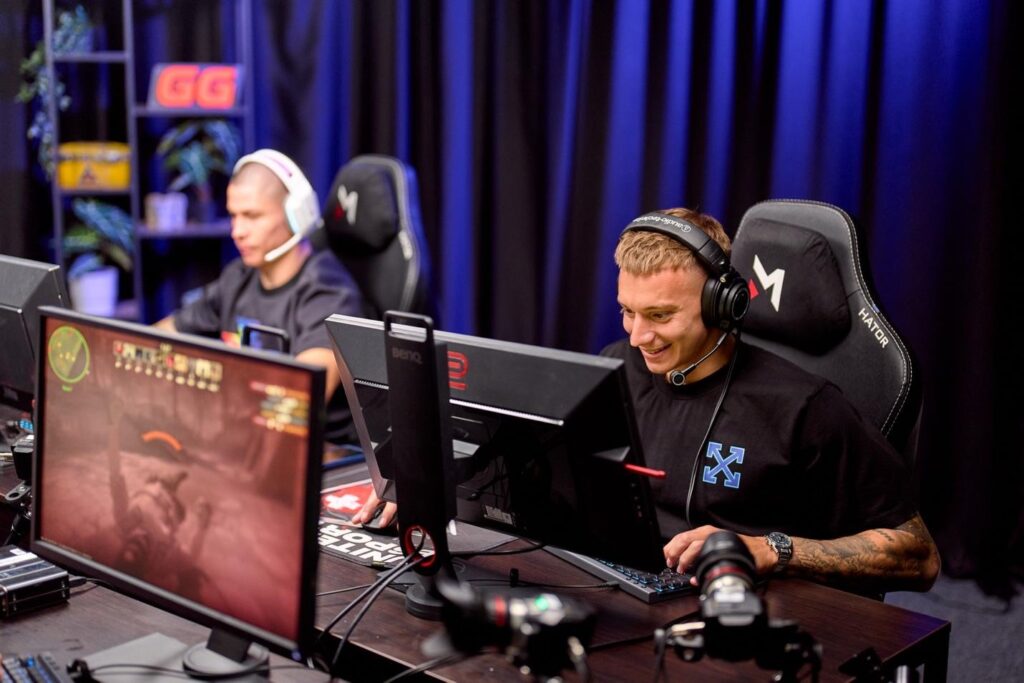
One of GG.BET’s projects at the intersection of the two industries that received huge fan support is Match of LeGGends: Derby on Server. It was the third show match in a series of non-standard competitions in which footballers at the legendary Dynamo Kyiv played Counter-Strike 2 (CS2) with NAVI players. The teams played together in this format for the first time, with mixed lineups, in non-traditional modes for competitive CS (Arms Race and others) and with non-standard rules (for example, additional health points for power balance). This match drew in over 220,000 viewers on the online platforms of the team and esports broadcasting studios, and over 40% of the Dynamo fans watching were interacting with esports content for the first time.
Projects like these serve a number of key purposes. New formats broaden the fan experience and help reach new audiences. The chance to see a favorite team or player in a new role and also be a part of this process attracts more attention than a special offer or publication. Also, cross-functional projects open up new business opportunities.
Wherever there’s an interesting idea, new formats for partnerships and investments tend to emerge. It helps to drive the market and attract brands that haven’t worked with sports or esports previously.
Sports and esports increasingly complement and feed each other. The various entertainment and content formats used by both industries are inevitably coming together in one big cultural space, where the main currency is fan attention. And uniting these various fan bases all over the world is what drives the non-standard ideas, collaborations, and projects that are born where these industries meet.
Sponsored content: This article was produced in partnership with GG.BET.

Follow The Esports Radar on social media: