


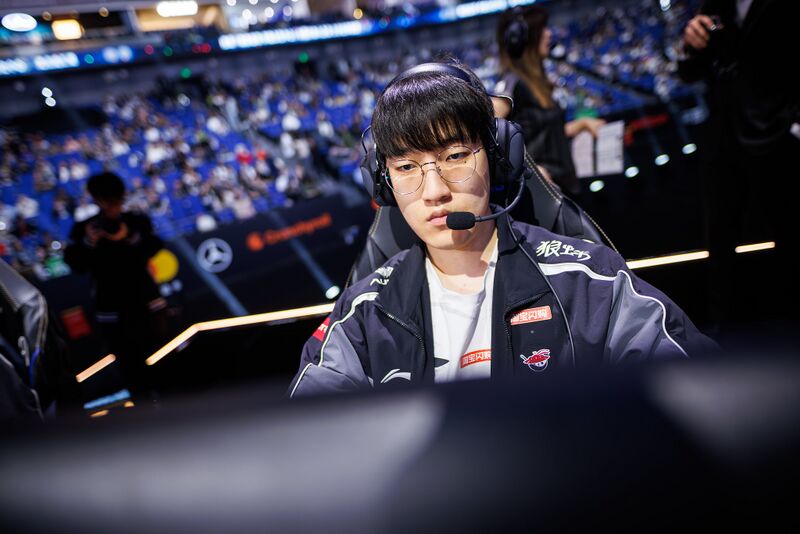


South Korea’s National Tax Service (NTS) has reportedly issued a comprehensive income tax assessment of KRW 3.54bn (~$2.65m) against South Korean League of Legends professional Lee “Tarzan” Seung-yong, who competes in China’s League of Legends Pro League (LPL) for Anyone’s Legend (AG.AL).
The information was first reported by South Korean tax and financial outlet Joseilbo.
In a pre-assessment review ruling issued in September 2026 and reported on 27 November 2026, the agency rejected the competitor’s claim of Chinese tax non-residency, determining that his primary personal and economic ties remained in South Korea between 2021 and 2024 despite residing in China for an average of 313 days per year.
Also read:
- Sports IT Solution expands EA SPORTS FCS Asia 27 esports tournament to nine countries
- REJECT reports $2.61 million net loss for fiscal year ended July 2026
- Gentle Mates becomes official Rainbow Six Siege partner team ahead of 2027 season
According to the NTS investigation records cited by Joseilbo, Lee, after debuting in South Korea in 2017 and transferring to the LPL in 2021, earned a combined KRW 6.3bn (~$4.72m) across the 2021–2024 tax years. However, only KRW 900m was paid directly to the player under a “Player Activity Agreement.”
The remaining KRW 5.4bn received between 2021 and 2023 was routed under a separate “Player Management Agreement” as corporate service fees to a South Korean agency incorporated by Lee’s family in January 2021. Lee held an 80 per cent controlling stake in the entity, with his parents and older brother holding the remaining equity and serving as chief executive officer and auditor. During the audit, the agency’s chief executive testified that the dual-contract structure was established specifically to comply with the LPL’s league-wide salary cap regulations by separating compensation above the cap threshold.
Following an integrated audit conducted between February and May 2026, the NTS reclassified the entire KRW 6.3bn sum as personal remuneration for Lee’s competitive gaming activities, assessing KRW 1.32bn for 2021, KRW 1.06bn for 2022, KRW 1.03bn for 2023, and KRW 117.48m for 2024.
In his June 2026 pre-assessment review filing, Lee did not contest the income figures but argued that he qualified as a tax resident of China under the Korea–China Tax Treaty, citing his 313-day annual stay in China, Chinese tax filings, a Chinese permanent residency permit obtained in April 2026, and cohabitation with his fiancée in China.
The NTS dismissed the appeal after evaluating the treaty’s “centre of vital interests” test. Regulators noted that Lee maintained his South Korean resident registration throughout the four-year period, that roughly 80 per cent of his Chinese earnings funded domestic family salaries and property acquisitions, and that the player failed to produce verified residential lease agreements in China.
For cross-border esports organisations and player agencies, the ruling underscores heightened regulatory scrutiny over dual-contract salary cap structures and cross-jurisdictional tax residency compliance. South Korea-based player agency Shadow Corporation aimed to address these concerns earlier this year by partnering with Shanghai’s Jinghuheng Law Firm to advise players and staff competing in the LPL.