

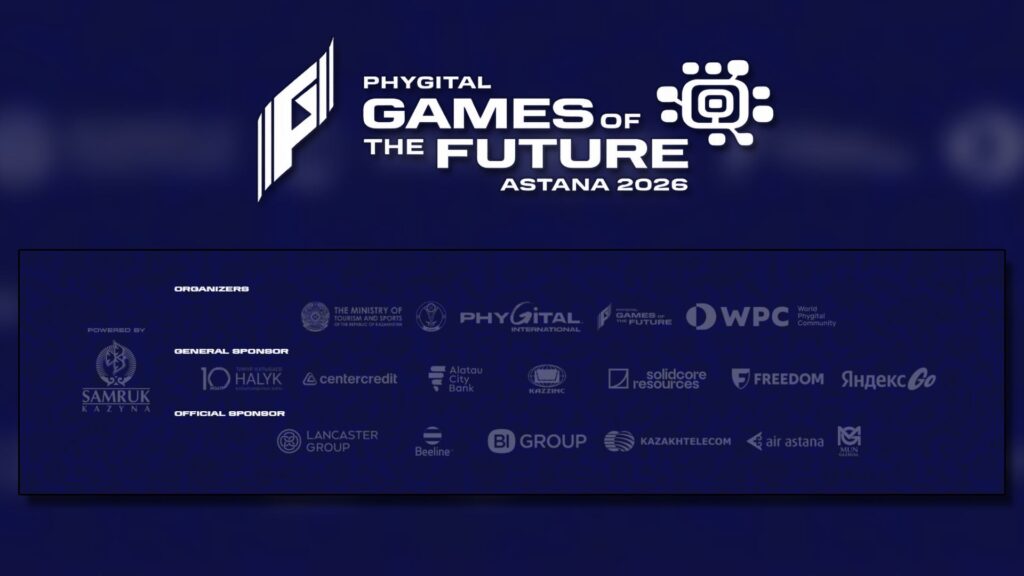


Phygital International, the official promoter and rights holder of the Games of the Future, has disclosed the full lineup of partners and sponsors backing the 2026 edition of the tournament, set to take place from July 29 to August 9, 2026, in Astana, Kazakhstan.
Leading the sponsor list is Samruk-Kazyna, Kazakhstan’s sovereign wealth fund. It’s the state’s main investment arm, which manages government-owned assets in industries like oil and gas, mining, transport, and energy. With Samruk-Kazyna on board as title sponsor, the 2026 edition will officially be branded “Games of the Future 2026, Powered by Samruk Kazyna.”
The event is organised by a small group of key bodies:
- The Ministry of Tourism and Sports of the Republic of Kazakhstan, the government body responsible for developing sports and tourism in the country, headquartered in Astana.
- Phygital International, the organiser behind the Games of the Future.
- World Phygital Community (WPC), a non-profit organisation that sets the rules and standards for phygital sports and helps run qualifying events leading up to the Games.
Apart from the title sponsor and the organisers, seven major companies have signed on as general sponsors:
- The Halyk Charitable Fund: a major private philanthropic organisation that finances wide-scale social welfare, healthcare, sports infrastructure, culture, and environmental projects across Kazakhstan
- Bank CenterCredit: another major commercial bank providing a full range of financial services.
- Alatau City Bank (formerly known as Jusan Bank): a retail and commercial bank offering cards, loans, and deposits.
- Kazzinc: one of the world’s larger zinc producers, also mining copper, lead, and precious metals; part of the Glencore group.
- Solidcore Resources (formerly Polymetal): a major gold mining company with operations across Kazakhstan.
- Freedom Holding (Freedom Bank Kazakhstan): a financial services group covering brokerage, investment banking, and retail banking across Central Asia.
- Yandex Go: the ride-hailing and delivery app that’s become a go-to for taxis, food delivery, and scooters across the region.
Finally, the following seven companies have come on board as the official sponsors of the 2026 edition:
- Lancaster Group: a diversified investment holding company with interests in finance, mining, infrastructure, and real estate.
- Beeline Kazakhstan: a major mobile network operator providing voice, data, and digital services.
- BI Group: one of the region’s leading construction and real estate developers.
- Kazakhtelecom: the national telecom provider, covering fixed-line, mobile, and internet services.
- Air Astana: Kazakhstan’s flag carrier airline, operating both passenger and cargo flights out of its hubs in Almaty and Astana.
Games of the Future is built around “phygital sports,” a format that blends traditional physical sports with esports. Athletes compete in two stages, first in a video game version of a sport, then in the real-life physical version, and their combined scores from both stages decide who wins.
For instance, in Phygital Basketball, teams first face off in a basketball video game where they play to rack up virtual points. Then the same athletes step onto a real-life basketball court to compete in the physical version of the sport.
The 2026 edition will feature a total of a $4.75 million prize pool and eight disciplines split across two categories: phygital sports, where physical and digital rounds are combined, and esports, including well-known titles like Dota 2, Counter-Strike, and PUBG.
Several of the world’s leading esports organisations are set to compete at the Games of the Future 2026, including Team Vitality, Team Falcons, T1, Twisted Minds, Virtus.pro, and Bigetron by Vitality, across multiple esports disciplines featured at the event.

Follow The Esports Radar on social media: