



Brazil has formally recognised esports as a sporting activity, as part of Decree No. 13,138, signed on 14 October 2026, that regulates the country’s legal framework for video games.
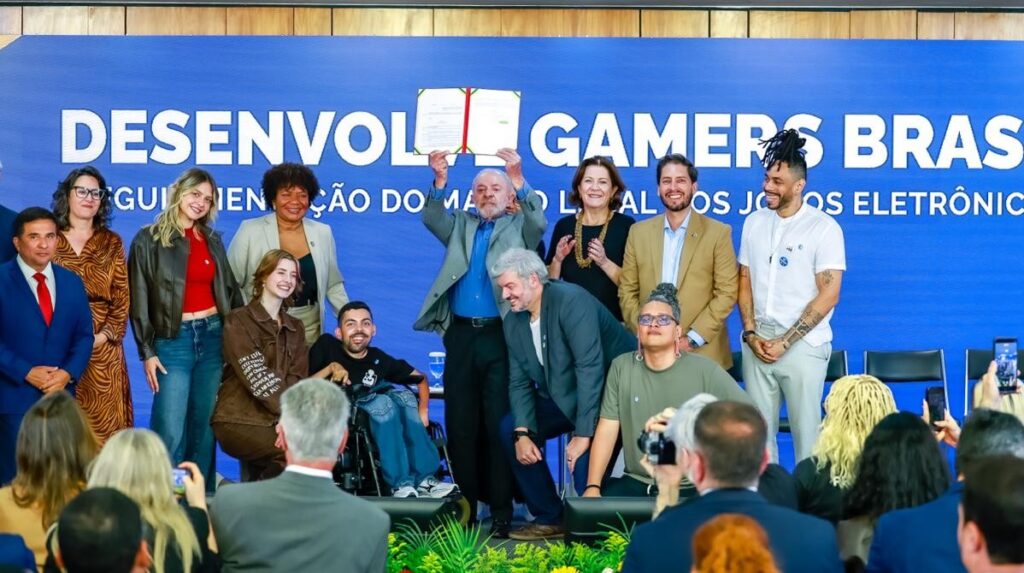
President Luiz Inácio Lula da Silva signed the decree regulating the Law No. 14,852/2024 (Legal Framework for Games), which was originally sanctioned in May 2024. The law recognises games as audiovisual works and cultural products, allowing companies to raise funds through government programs and to access cheaper credit.
Articles 20 and 21 of Decree No. 13,138 specifically establish the legal status of competitive gaming within Brazil’s national administration. Article 20 defines esports as a competitive sporting manifestation, conducted individually or collectively via digital games with pre-established rules, while Article 21 permits esports organisations to integrate into the National Sports System (Sinesp) and participate in public policies spanning athlete development, tournament support, scientific research, integrity, and social inclusion.
Also read:
- FIFAe Finals 2026 postponed to an unannounced date
- Danish payments firm Flatpay partners with Astralis through 2027
- Daniel Tsay steps down as General Manager of Call of Duty Esports
In an exclusive interview with The Esports Radar, Cadu Albuquerque, National Esports Director at the Brazilian Ministry of Sport, clarified the operational scope and realistic expectations of the decree.
“The decree establishes a legal foundation for integrating electronic sports into public sports policies, but it should not be confused with the automatic granting of public subsidies or state takeover of esports management,” Albuquerque explained, “access to public resources will depend on the existence of suitable programmes or instruments, participation requirements, budget availability and other legal requirements. The same applies to scholarships, tax incentives and other forms of financial support, which are not directly guaranteed by Articles 20 and 21.”
Addressing the implications for established commercial ecosystems, such as the Brazilian League of Legends Championship (CBLOL) by Riot Games and the regional Rainbow Six Siege circuit by Ubisoft, Albuquerque emphasised that publisher intellectual property rights and commercial models remain fully protected: “The recognition does not mean that consolidated competitions need to alter their formats, calendars, or commercial models, nor does the Ministry of Sport intend to interfere in competitive decisions,” Albuquerque stated.
“What changes is the potential for public policy co-operation, such as grassroots player development, gender inclusion, academic research, and integrity initiatives to combat match-fixing and harassment.”
Similarly, international tournament operators such as ESL FACEIT Group and BLAST hosting major arena events in Brazil will be able to structure complementary workforce training and community outreach initiatives alongside public institutions. However, Albuquerque noted that hosting a commercial tournament in Brazil does not automatically guarantee government subsidies, as all entities must meet rigorous administrative and legal criteria to qualify for specific public support instruments.
Beyond esports, under the regulated framewor, domestic video game developers can now access federal tax incentive mechanisms. Game development enterprises are also eligible for low-interest credit lines backed by the Ministry if Science, Technology and Innovations and the Audiovisual Sector Fund (FSA).
To promote national intellectual property, the federal government announced the launch of Game Brasil, a public platform backed by an initial R$1.4m (~$280,000) investment designed to catalogue and promote Brazilian-made video games across domestic and international markets. Additionally, the Ministry of Education will establish undergraduate gaming degree programmes across five federal universities, offering 230 accredited places to build domestic technical talent.