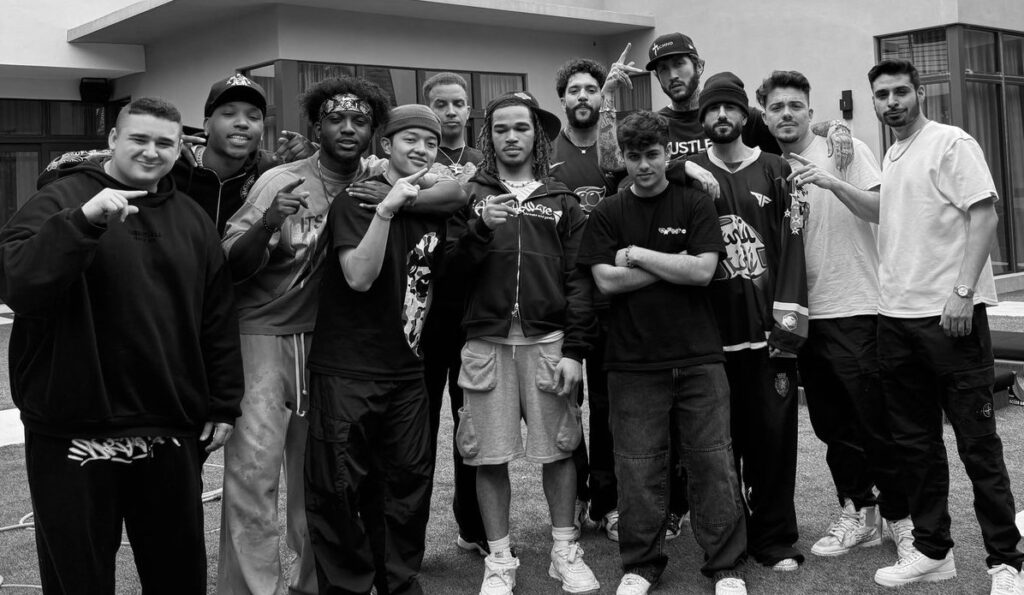


For much of esports’ development since the late 2010s, content sat in the driving seat. Cultural relevance, reach and commercial momentum were often shaped more by personalities than by podium finishes. In some organisations, competitive gaming became more akin to the backseat driver – sometimes even more comparable to a passenger — rather than the driver of the vehicle itself. FaZe Clan based in the United States and Brazil’s LOUD are two of the most prominent examples of this era.
That shift did not emerge by accident. Creator-led strategies delivered scale in a scene where trophies alone rarely guarantee sustainability. Content can expand exposure beyond tournament cycles, broaden and scale reach, reduce dependence on competitive variance, and can align naturally with platform economics optimised for engagement. Competitive success still matters — trophies always played a key role for top tier organisations — but it was not necessarily the clearest signal of where organisational focus truly sat.
The question facing the industry today is not whether content works, but what happens when esports organisations are forced to choose what they are first: a competitive entity amplified by content and with a dedicated arm, or a media business that also operates competitive gaming teams.
FaZe Clan and a model under strain
GameSquare completed its acquisition of FaZe Clan in March 2024, after earlier agreements were announced in late 2023. Following the acquisition, GameSquare split FaZe into competitive esports operations and a separate media/content arm. By April 2025, GameSquare had fully divested the FaZe Media business while retaining 100% ownership of FaZe Esports.
In late 2025, a significant portion of FaZe Clan’s creator roster, including names like Stable Ronaldo, Silky, Lacy, and JasonTheWeen, departed the organisation. While creator movement is not unusual, the scale of this exit coincided with a broader structural shift.
What followed was not simply a reshuffle of talent, but a breakdown in the sustainability of the creator-led model as it had previously existed. Public discussion around the creator exodus repeatedly referenced “unsustainability” — a term long associated with team operations since the onset of the ‘esports winter’ around 2023, but far less commonly applied to content and the creator space. FaZe operated at exceptional scale, with unusually high-cost structures, long-term creator agreements, and lavish centralised infrastructure that few organisations attempt to replicate. In that sense, the situation may say as much or more about FaZe’s specific execution than it does about the model itself.
Creators naturally retain primary loyalty from their own audiences. While this generates scale and daily relevance, it does not always translate into long-term organisational equity. At the same time, team-level sponsorship structures can limit the commercial flexibility of individual creators, introducing friction with partners, fans and — eventually — the creators themselves.
Many of FaZe Clan’s challenges also predate its most recent restructuring. As detailed by Digiday, earlier phases of the organisation’s growth exposed structural weaknesses around governance, brand oversight and leadership accountability, particularly as the organisation scaled rapidly on the back of creator-driven visibility. High-profile controversies linked to crypto promotions and influencer behaviour did not create FaZe’s financial issues, but they amplified underlying instability and eroded partner confidence at a critical moment.
On the other hand, FaZe’s competitive identity remains strong. Under GameSquare, the organisation continues to operate as a recognisable, premium esports brand, increasingly insulated from the volatility that defined its creator ecosystem. While we do not have visibility on specific FaZe Esports finances, GameSquare Q3 results reported net income of $5.9m from continuing operations in Q3 2025, alongside a sequential improvement in gross margin to 49.4%. The company ended the quarter with $81.5m in cash and DAT assets, no debt, and shareholders’ equity of $78.7m, which management described as the strongest balance sheet in its history.
LOUD and the pivot toward competitive permanence
LOUD’s trajectory offers a different, but equally instructive, perspective. The Brazilian organisation rose rapidly during the COVID-19 period through a powerful combination of content and lifestyle branding. LOUD was closely associated with creator houses and viral content. From 2021 onwards, however, LOUD increasingly consolidated its identity around competition.
The organisation has since won four CBLOL titles, claimed the 2022 VALORANT Champions world title, and secured a VCT Americas league championship. As a result, LOUD is now primarily recognised as a winning organisation rather than a content collective that happens to field teams. Content remains present, but it is no longer the foundation.

Content scale is not immunity — but it remains essential
FaZe and LOUD are not isolated cases. Even organisations widely viewed as benchmarks for content-driven success have faced similar realities. 100 Thieves, a hybrid organisation that has tested multiple business models, with long-term success emerging where content, culture, and distribution intersect, was forced to restructure, exit major competitive ecosystems such as the North American League of Legends scene, and scale back operations during the same period of economic contraction.
While 100 Thieves’ financial pressures cannot be attributed solely to its content-led structure — given the organisation’s investments across peripherals, an energy drink brand, and a now-shelved game studio — cultural relevance and creator reach did not exempt the organisation from the broader market forces impacting the industry. More recently, the organisation returned to the headlines exactly through a renewed competitive push, announcing its entry into the Counter-Strike scene alongside high-profile signings, including the recent addition of CS legend Nicolai “dev1ce” Reedtz.
At the same time, it would be misleading to frame this as a retreat from creators. Teams such as G2 Esports and Team Liquid illustrate a different equilibrium. Both organisations invest heavily in content, but their media output is structurally anchored to competitive identity — players, rivalries, matches and performance. Content acts as an amplifier, not a parallel business.
Team Liquid’s Liquid Media and G2’s agency, 62, were established as separate businesses, leveraging experience gained from producing content around their esports organisations to offer creation as a service to third-parties. In both cases, content is positioned as infrastructure: a scalable capability designed to generate revenue. As a result, these operations can expand alongside esports activity or contract when necessary, without threatening the organisations’ core stability.
Identity before optimisation
This is not a prescription for organisations to abandon content in favour of competition. Sponsorship remains the primary revenue driver for most teams, and sponsorship relies on reach, engagement and storytelling — areas where creators are indispensable. Nor is the FaZe situation necessarily representative of the creator model at large.
Other organisations have successfully moved in the opposite direction: Misfits transitioned away from esports into a creator-focused media and production business, while groups such as POWR in Saudi Arabia have leaned more heavily into creator ecosystems while maintaining selective competitive involvement.
What this edition of Heat Map reflects on instead is an identity question. As capital becomes more disciplined and ownership groups reassess risk, organisations are being forced to clarify what they are optimising for: competitive legitimacy, commercial scale, or a carefully managed balance between the two. Content and competition are not opposing forces — but when they pull in different directions, the decision of which one leads inevitably shapes brand and company positioning, values and long-term strategy.
This analysis was first published in the Heat Map newsletter on 07 January 2026. For early access to our analysis and more exclusive content, subscribe to The Esports Radar’s newsletters via this link.
Follow The Esports Radar on social media: