

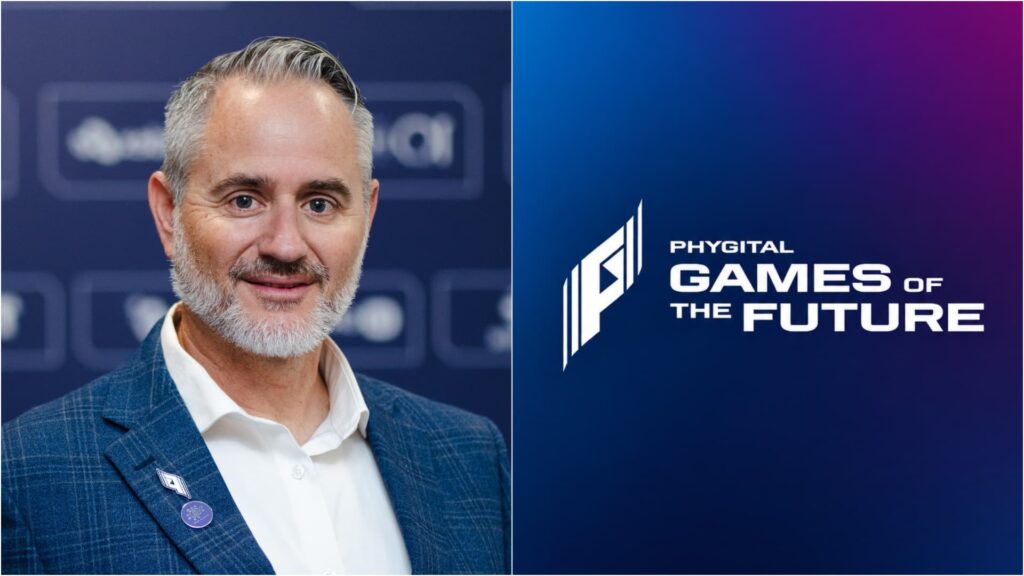


Phygital International CEO Daniel Merkley spoke exclusively to The Esports Radar about the Games of the Future’s growth, finances, Russian roots, and plans for global expansion.
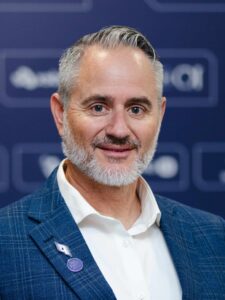
Daniel Merkley took over as CEO of Phygital International just two weeks before the Games of the Future 2026 (GOTF), held in Astana, Kazakhstan, from July 29 to August 9, 2026. He isn’t new to the world of phygital sport, a format that pairs a video game discipline with a corresponding physical activity, having previously led the World Phygital Community as Chairperson/Managing Director, overseeing the grassroots side of the movement.
But stepping into the top job at the organisation that owns and runs the Games of the Future puts him in charge of an event still fighting to shake off questions about its Russian origins, particularly in the wake of Russia’s war in Ukraine, as well as concerns about its finances and whether Western athletes can trust it.
We spoke with Daniel Merkley during the GOTF’s Astana edition to take a closer look at the business behind Phygital International and its flagship event, the Games of the Future.
Daniel Merkley’s plan: Prioritising audience growth over any other metric
When asked what he wants to change and which number he wants to grow most in his first year, Merkley said he does not want to change the current direction. Instead, he wants to accelerate the work that is already underway. His main goals are to build long-term relationships with host cities, publishers and sponsors, improve the experience for athletes and fans, and bring phygital sports to more people around the world.
Asked to pick a single metric to grow in his first year, Merkley said, “I would choose audience. We already know there is significant appetite for the Games of the Future, with hundreds of millions of viewers worldwide, and Astana has continued to extend that reach internationally.”
Phygital International’s ownership and revenue sources
That focus on growth naturally raises a more basic question: who actually owns this company, and is it making money? On ownership, Merkley was direct about what he would and would not say. Phygital International is a privately held, for-profit organisation based in the United Arab Emirates (UAE), started with private seed funding and early backing and involvement from established sports figures René Fasel and Philippe Blanchard.
Fasel brought decades of experience running international sports organisations, including 27 years leading the International Ice Hockey Federation and serving on the International Olympic Committee (IOC)’s Executive Board. Blanchard brought experience in sports, technology and major international events, including work with the IOC and Expo 2020 Dubai. Together with other early contributors, they helped develop the idea of combining real-world sports with digital gaming, which later became known as phygital sport.
Beyond that, he declined to name shareholders or investors or disclose whether the company is currently profitable, citing its status as a private organisation.
However, he was clearer on how the business makes money. Merkley explained that the company primarily earns from licensing fees paid by host cities, along with sponsorships and other commercial partnerships. He also clarified each host city raises and manages its own budget for its edition, which means Phygital International does not fund host cities, and host cities do not subsidise Phygital International. The company’s role, as he described it, is to license the rights and event brand, not write checks.
Following the money further, we asked what a host city actually pays for. Merkley confirmed the Games of the Future now uses a competitive bidding process similar to how cities bid for the Olympics. However, on the licensing fee, he said, “The commercial terms of individual host agreements are confidential, so we don’t disclose the licensing fee paid by a particular city.”
He did offer numbers from Astana as an example of how the money works in practice. Merkley revealed that Kazakhstan’s Vice Minister of Tourism and Sports, Serik Zharasbayev, put the total budget of the Games of the Future 2026 Astana event at roughly 24 billion Kazakhstani tenge (approx. $52.75 million), with just under 10 billion tenge (approx. $21.98 million) coming from the state and the rest, more than half the total, coming from sponsors and organisers.
One number that has moved in the opposite direction is the prize pool, which dropped from $10 million at the first Games in Kazan to $4.75 million in Astana, a drop that invites an obvious question about whether the event is scaling back.
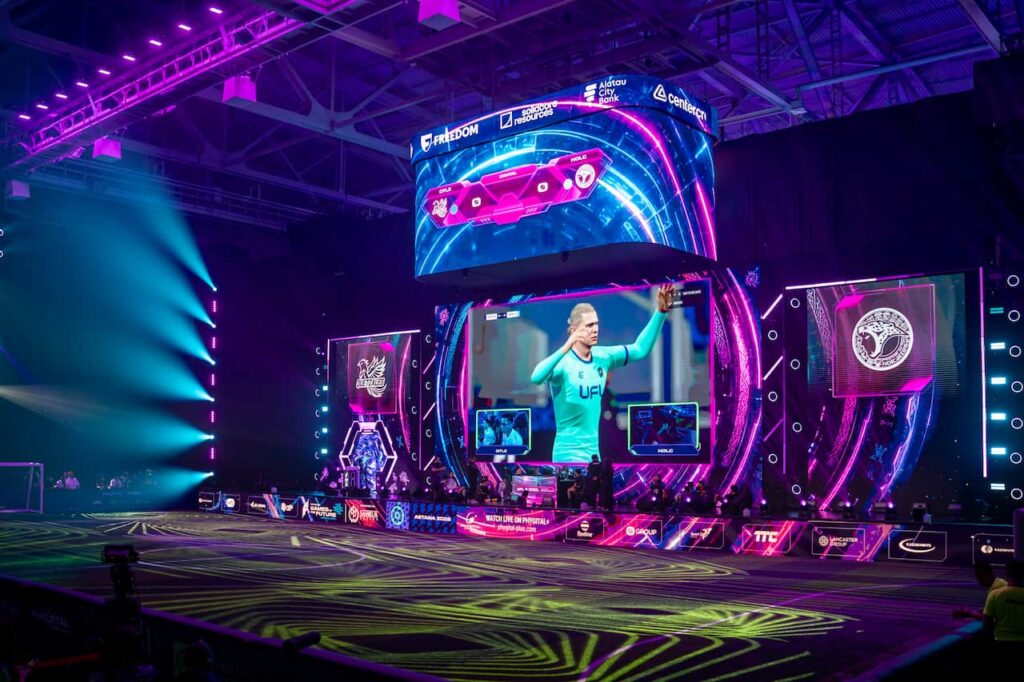
Merkley pushed back on comparing the two directly. Kazan, he said, was an early proof-of-concept event testing 21 disciplines in a format that barely resembles today’s competition, so the prize pools are not really measuring the same thing. He explained Astana featured eight disciplines, including $1 million prize pools each for Dota 2 and PUBG: BATTLEGROUNDS, with popular esports clubs like Team Vitality, T1 Esports, Virtus.pro, LGD Gaming and more participating in the competition.
The 2025 Abu Dhabi edition, by comparison, featured 11 disciplines with roughly 850 athletes from more than 60 countries and a prize pool of around $5 million. His point was that each host builds its own competition programme and budget, so the number of disciplines, rather than some hidden cost-cutting, explains the swings in total prize money.
“For us, the measure of progress is broader: the quality of competition, the athletes and clubs we attract, the audience we are building, the experience for fans, the value we create for partners and hosts, and whether we are building a sustainable international sporting property for the long term. Prize money remains an important part of that proposition, but our ambition isn’t simply to compete on the size of the prize pool. It’s to build an event that athletes want to compete in, audiences want to watch and partners and host cities want to be part of,” Merkley said.
Prize money led naturally into a question about the Games themselves, specifically how Phygital International deals with major game publishers such as Valve, KRAFTON and MOONTON.
On the commercial terms, Merkley stated, “Every publisher, title and market is different, so those relationships are structured individually. As you would expect, the specific contractual and commercial terms are confidential, and I can’t discuss individual revenue-sharing or licensing arrangements.”
What he did describe was the pitch to publishers: access to a sporting environment that combines gaming, physical sport and entertainment, along with opportunities beyond simple licensing, such as in-game integration, co-branded content and joint fan campaigns. He pointed to publishers that returned from the 2025 Abu Dhabi Games for the 2026 Astana Games as evidence that those relationships are sticking.
Phygital International’s Russian origins and its current independence
Phygital International and Games of the Future have received criticism over alleged ties with the Russian government. For context, The Games of the Future was launched in the Russian city Kazan in 2023 under a law signed by Russian Deputy Prime Minister Dmitry Chernyshenko, a sanctioned individual who was directly involved, while Vladimir Putin appeared at the launch.
Two years and two host cities later, we asked how much real distance exists between the company and its Russian state origins. Merkley said, “Phygital International has always been an independent organisation headquartered in the UAE and the rights holder and custodian of the Games of the Future. No government owns, funds or directs the global event or our operations.”
Merkley’s answer also separated where the concept was first tested from who controls it now. Kazan, in his account, was chosen as the location for an early large-scale trial of the format, establishing rules, disciplines and logistics. But that does not amount to ownership or control.
He pointed to the rotating host model as evidence of that independence: Abu Dhabi hosted in 2025, Astana in 2026, and bids for 2027 have come from as far afield as Brazil and Serbia, with bidding now open for 2028 through 2030. The long-term ambition he described is a genuinely global, five-continent rotation, rather than an event anchored to one country.
Those alleged Russian ties have also led some participants to walk away from the tournament during its short history. In December 2025, several prominent Dota 2 figures, including Sébastien “Ceb” Debs and Johan “N0tail” Sundstein, pulled out of the Abu Dhabi Games, specifically citing its Russian political ties, while Alliance’s Jonathan “Loda” Berg withdrew, citing unspecified “circumstances”.
Nearly a year later, we asked what had actually changed that would bring a sceptical Western player or sponsor to the table now and whether Merkley accepts the broader criticism that the Games function as a Russian soft-power project.
Merkley stated that “We respect that individuals make their own decisions about where they compete. At the same time, some assumptions that circulated reflected misunderstandings over how the Games of the Future is structured, funded and operated, and we have sought to provide greater clarity around that directly at the time.”
He further added, “I think the development of the Games of the Future since then speaks for itself. This is an event designed to move around the world, with each edition bringing a new host city, new partners and new communities into the ecosystem. We’ve seen athletes and clubs from around the world compete, publishers and commercial partners continue to work with us, and growing international interest in hosting future editions.”
On the soft-power accusation specifically, his answer was a flat denial. “The competition itself is also club-based: teams compete for their clubs, not as national representatives, bringing together athletes from around the world.” Merkley said, “So, on the suggestion that the Games of the Future is a soft-power project for any one country, or that it is formatted to prop up nationalised victories on the podium, our position is straightforward: it isn’t. The Games of the Future is an international sporting property designed to travel from city to city, celebrating multinational club teams, at the heart of a global phygital movement that continues to grow around the world.”
Games of the Future’s sponsorship model and ROI
We shifted from politics to money, asking what companies like Logitech and Sven are actually buying into by sponsoring the Games. Merkley described the Games’ pitch to brands as access to a young, digitally native audience across gaming, esports, traditional sport and entertainment, all in one place.
He cited figures from Abu Dhabi 2025, disclosed by Phygital International itself and attributed to market research firm Ipsos: 461 million broadcast views, 59 million hours watched and 388 million social views, with viewership skewing 90% toward ages 18 to 34. He also pointed to Astana 2026’s distribution through 289 broadcast and streaming outlets in more than 150 countries and across more than 20 languages.
Those same performance metrics are also published on the website of marketing agency Crowd, which ran the event’s digital campaign. According to the agency, the campaign targeted audiences from social platforms such as Meta, TikTok, YouTube, X, Telegram, Douyin, WeChat, and Weibo, the three latter widely popular in China. The campaign generated 137 million in total reach, 388 million social media views, 59 million hours watched, and 819,000 new followers, broadly in line with the figures mentioned by Merkley during the interview.
Clarifying the context behind these metrics, Tom Berne, Managing Director at Crowd in the UAE, noted on social media that the campaign results reflect cumulative metrics gathered over a full year across five languages and accounts managed for the client, with the Abu Dhabi event itself serving as the primary driver of engagement.
He used Alibaba Cloud as an example of a partnership going beyond standard sponsorship. The company is the official cloud infrastructure partner for the 2026 and 2027 Games, hosting the event’s broadcast content library, with plans to expand into global media rights distribution from 2027.
More broadly, he said different sponsors define return on investment differently, whether through brand visibility, product integration, hospitality or association with innovation, and that deals are built around what a specific company wants rather than a fixed sponsorship package. He also flagged an ambition to build year-round engagement around the Games and its qualifying events, rather than a relationship that resets each year.
That led to the broadest question of the interview: What is this all actually for? Asked directly whether the Games of the Future exists to turn a profit or serve some other purpose, in the way Saudi Arabia’s Esports World Cup is widely understood to support a national strategy rather than chase revenue for its own sake, Merkley said commercial sustainability matters, but it isn’t the reason the event exists.
Merkley explained that “commercial sustainability absolutely matters. No serious international sports property can continue to grow, innovate and invest over the long term without a viable commercial model.” He further added, “But making money isn’t the reason the Games of the Future exists. The ambition is much bigger: we believe we are building a new category of sport.”
He was candid that the organisation is still early in that process and has significant work ahead, pointing to growth in athlete numbers, audiences, partners and host city interest as the basis for his confidence, rather than claiming the model is already proven.
With the 2026 Games now complete, Merkley’s focus is on what comes next: growing the audience, building new partnerships and introducing phygital sport to more people around the world.
The next few editions will be important as the GOTF moves to new host cities and reach new audiences. Phygital International will also need to take clear steps to build trust with athletes, game publishers, sponsors and fans, including through marketing, public information and other outreach campaigns that address the criticism surrounding the event’s origins. This will be particularly important as it looks to grow beyond the markets where the event has already been held.
For now, the Games of the Future is still a young event with plenty of room to grow. As Phygital International looks ahead to its next editions, the focus will be on building on what has already been created and seeing where the concept can go from here.