

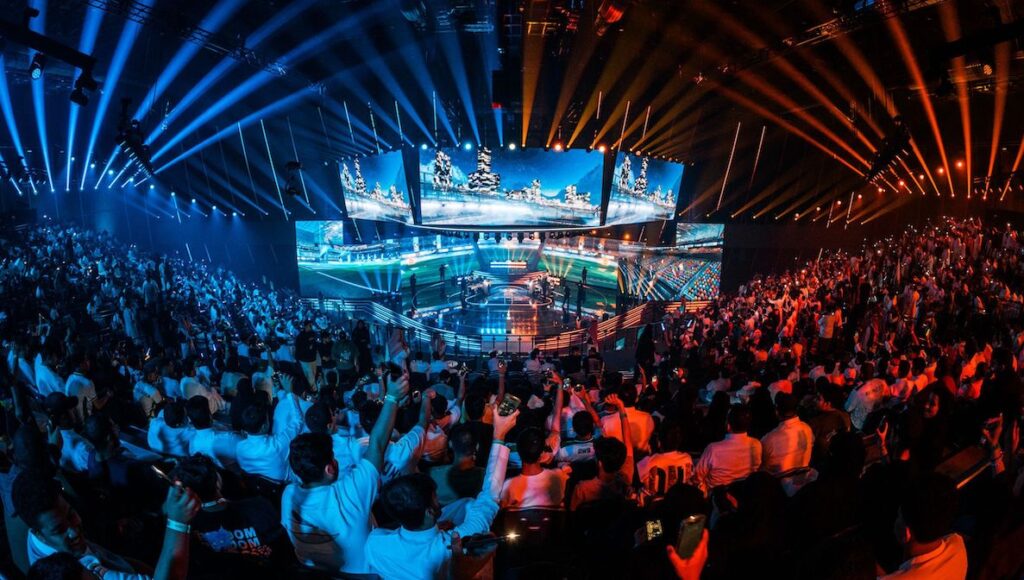


As the 2026 Esports World Cup (EWC) cycle begins, one of the recurring questions around the ecosystem is what impact the competition can have beyond the tournament itself.
That topic was discussed during a Media Rumble hosted by the Esports Foundation (EF, formerly Esports World Cup Foundation) on 27 April, where executives from several leading organisations addressed roster planning, fan development, mobile esports growth and the role of the Esports World Cup Club Partner Programme.
Now in its third edition, the $20 million initiative offers direct financial support of up to $1 million per club to expand global reach, create content and develop narrative-driven fan campaigns leading into the EWC. While the programme still provides substantial backing for participating organisations, this year’s selections have also drawn attention for a stronger emphasis on rapidly growing markets.
Also read:
- Suzuki named global sponsor for Evo 2026 tournament circuit
- L’Oréal Paris taps women’s esports with one-off FURIA collaboration
One of the concerns raised by The Esports Radar around the event is whether some organisations may build short-term rosters specifically for the competition, only to reduce investment afterwards.
Cloud9 CEO Jack Etienne said that, from his organisation’s perspective, participation in key titles is not dependent on the Esports World Cup. His comments suggested that, for organisations already committed to major ecosystems, the tournament is an additional opportunity rather than the basis of their involvement.
“The four major games that we’re involved in — VALORANT, League of Legends, Rainbow Six and Call of Duty — are also all games that participate in EWC,” Etienne said. “Whether EWC was something that we were participating in or not, Cloud9 would have a space in these games. So after EWC, we’re still gonna be there regardless.”
Team Vitality Chief International Officer Danny Engels said his organisation has sought to avoid signing players solely for the event.

“We should not be hiring players for just EWC, because then the longevity behind the investment doesn’t really stick,” Engels said. “And it doesn’t really help the players either, to not have the stability.”
Engels pointed to Vitality’s relationship with Tekken player Jeon “Jeondding” Sanghyeon as an example of a broader approach, describing how the player became involved with content and fan engagement activities in addition to competition. “He really embraced being part of the brand,” Engels said. “Played part in content, engaged with our fanbase.”
According to Engels, that led to a longer-term agreement: “We basically saw him as such a great ambassador, we already renewed him until 2030,” he said, “without even having the confirmation that Tekken will be there until the 2030 Esports World Cup.”
He also noted that short-term recruitment can create commercial challenges.
“If you are an organisation that only hires players for the Esports World Cup, you will be ending up paying premiums on these player salaries,” Engels said, “and will have a much harder time to convince the players to join your club instead.”
Another subject discussed was whether the Club Partner Programme could contribute to more stable revenues for teams. G2 CEO Alban Dechelotte focused on the distinction between audience size and long-term supporter loyalty.
“There’s sometimes confusion between followers and fans,” Dechelotte said. “If you add new players, new games, new countries, you escalate your number of followers mechanically. But the big question is, how do you build this in the long term?”
Dechelotte said G2’s strategy centres on identity and consistency across titles. “We have our secret sauce, which is not so secret,” he said. “A lot of unique tone of voice, content, storytelling.”
He explained that the aim is for supporters who discover G2 through one title or player to remain connected with the organisation elsewhere. “The fans choose us,” he said, “and not just follow us.” He added that the programme has supported broader brand activity: “The programme enabled us to create these cultural moments in a way that probably we could not afford, we couldn’t do without.”
Hans Jagnow, Director of Clubs, National Teams & Player Relations at EF, described the initiative as a long-term enabler rather than a direct revenue solution.
“As a programme itself, we’re not a dedicated revenue model,” Jagnow said. “What we’re doing is helping clubs invest into creating the capabilities of being more diverse within their offering towards the wider economic partners.” He cited content operations, staffing and commercial development as examples.
“Overall, I think the club programme is an infrastructural investment that allows clubs to generate more revenues down the road,” Jagnow said.
The discussion also covered mobile esports and the inclusion of regional organisations such as FUT Esports from Turkey and mobile-first teams like Alpha 7 from Brazil in the Club Partner Programme.
Besides expanding to regions aiming to become “true global”, Jagnow said mobile titles have become an important driver of growth, particularly in mobile-first markets.
“Mobile esports has been over the last year one of the driving factors for growth of the global esports ecosystem,” he said, “especially into countries that are mobile-first.”
“It is an undeniable part of the esports ecosystem,” he added.
Team Liquid co-CEO Steve Arhancet said the organisation’s strategy has adapted alongside these wider industry changes.
“We’ve been around for 25 years,” Arhancet said. “The industry has changed quite a bit, and we need to change with it. That adaptability is why we see ourselves as a multi-generational esports organisation.”
“Mobile Legends: Bang Bang is the second most watched esport in the entire world,” he continued, referencing live attendance figures for the record-breaking Honor of Kings 2025 King Pro League (KPL) Grand Finals. “If we want to be the largest, then we’ve got to play ball in those new games.”
The discussion points to a shared recognition among major teams and the Esports Foundation that short-term thinking — whether in roster construction, fan acquisition, or revenue models — has limits. Rather than positioning the Esports World Cup as a singular make-or-break event, several organisations are treating it as one component within a longer operational timeline.

Follow The Esports Radar on social media: