

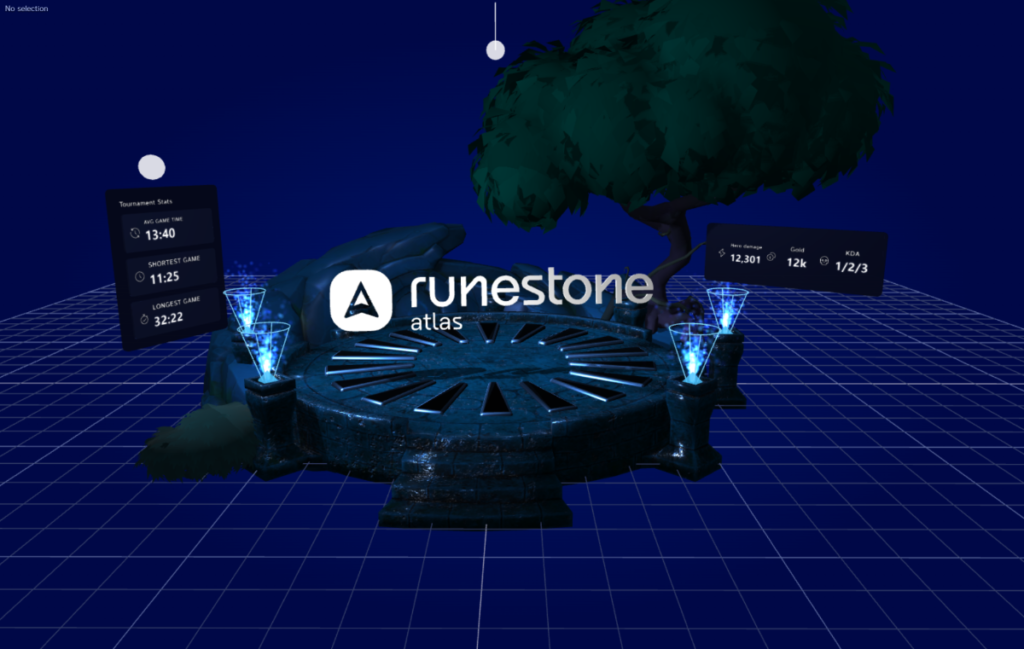


Esports technology developer Runestone has introduced Atlas, a multi-game broadcast graphics and production platform designed to convert real-time and historical match telemetry into 3D visual environments for live tournament broadcasts.
The tool aims to address stagnant stream presentation formats across both Tier-1 publisher circuits and regional Tier-2 tournament ecosystems. Atlas improves the storytelling of a match through data, unlocking opportunities for the broadcast to integrate commercial partners at the same time it enhances the viewer experience.
According to Runestone, through Atlas organisers can customise which data points appear and present them in 3D, building ad hoc visual narratives around what’s happening in a match rather than defaulting to a fixed overlay. A player accumulating an unusual amount of in-game gold, for instance, will be visualised directly in the 3D environment rather than as a number in a corner of the screen.
Aleksandar “Bukka” Bukurecki, Head of Product Development of Atlas at Runestone, described the underlying goal as turning raw broadcast data into something closer to narrative. “We built Runestone Atlas to transform static data into living, breathing stories within immersive gaming worlds,” he said.
Shane Clarke, Managing Director of Runestone, framed the opportunity in terms of how little the broadcast viewing experience has evolved. “The viewing experience hasn’t changed in a long time, and organisers are content with that fact.” Clarke previously highlighted in an interview with The Esports Radar that data serves as a foundational pillar for narrative building and fan retention. By transforming raw telemetry into intuitive, immersive visual storytelling, the company seeks to deepen audience engagement and elevate standard broadcast experiences across the industry.
Also read:
From a commercial perspective, the platform addresses two persistent pressure points facing tournament organisers: production costs and sponsor monetisation.
For the monetisation pillar, sponsors and partners can be integrated live into the broadcast, which arguably can feel more authentic to viewers than a bolted-on ad placement. This extends to the graphics themselves: Runestone said it can create completely unique, native settings for individual sponsors, including sponsored activations within stats. Atlas then enables sponsors and partners to be integrated live into the broadcast, weaving them directly into the match narrative in real time.
Plus, rather than an operator manually deciding what to highlight, the ambition is for the tool itself to surface moments worth telling a story around. By automating data visualisation and simplifying the graphics control layer, Atlas aims to reduce the physical manpower required in the control room, lowering operational execution demands for independent tournament operators and allowing resources to be allocated to other strategic areas that will enhance the event experience.
How the builder works
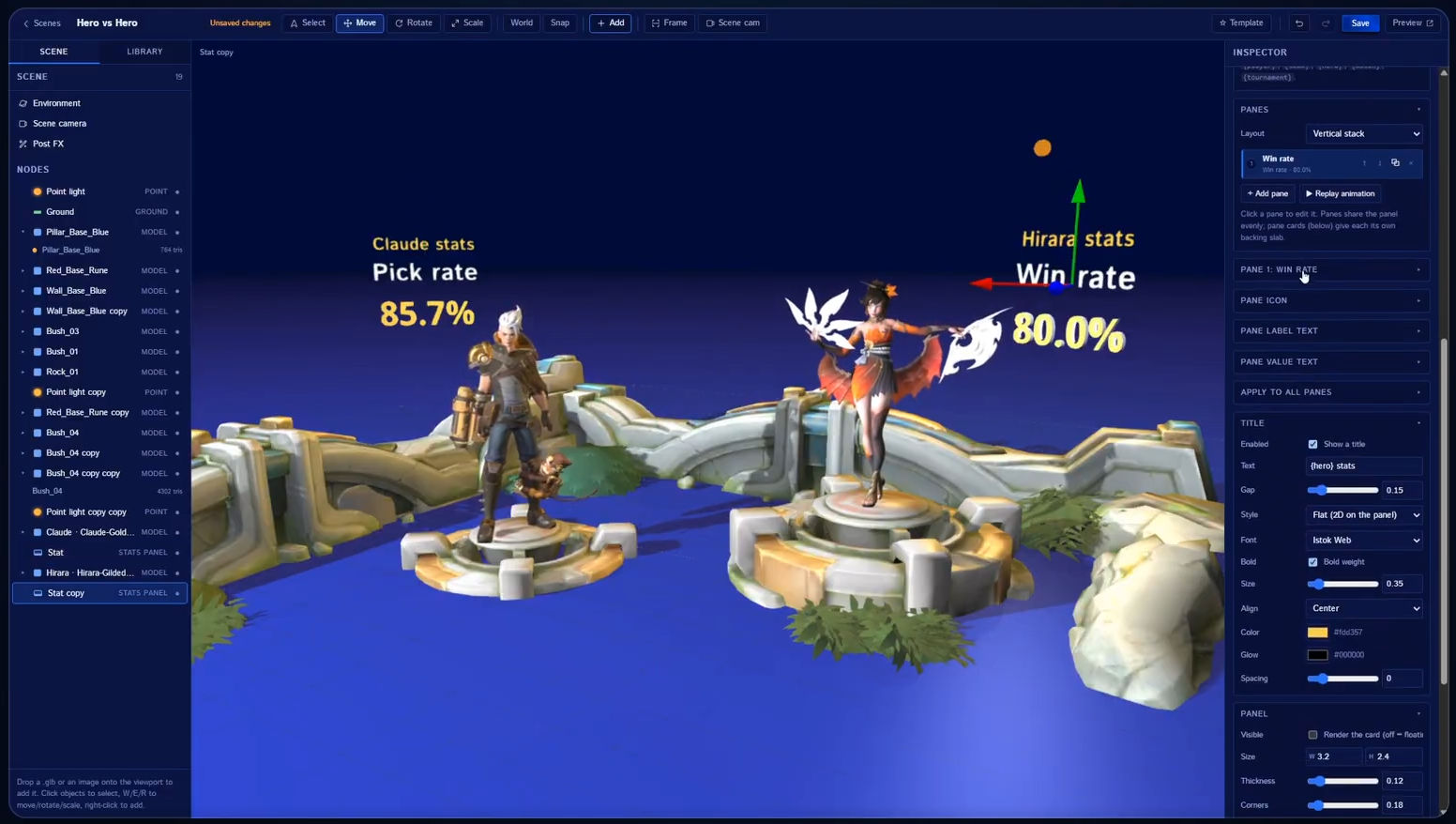
Atlas works as a 3D sandbox. Bukka said users can build scenes from Runestone’s asset library or import their own 3D files, while an integrated data layer pulls historical or real-time data points directly into the editor.
“You have full control to build scenes using our extensive asset library or your own imported 3D files. However, the game-changer is our integrated data backbone, which lets you pull in historical or real-time data points directly inside the editor,“ Bukka told The Esports Radar. “Our next step is implementing AI tools that can intelligently suggest data outliers and seamlessly integrate them into the physical environment of your 3D world.”
Clients will have access to the builder and can use it for any game they choose, according to Runestone. At launch, however, Runestone will assist with building and implementation.
SURGE, which runs the Mobile Legends: Bang Bang (MLBB) Western Europe ecosystem, will pilot Atlas during its October MLBB tournaments. Jaroslav Melišek, CEO of SURGE, said Runestone has been a partner since the early stages of the ecosystem, and that the company has supported more than infrastructure.
Melišek said SURGE’s interest goes beyond the live broadcast. Because Atlas generates animations natively, SURGE is exploring it as a content engine for social, building on existing plans for short-form highlight and player stats content. “Highlights with live data layered in. Stats that actually look good. Short form videos that do more than clip a play.”
He also pointed to the sponsor layer as a way to change conversations with brands: “What Runestone built is not just a broadcast upgrade. The dynamic sponsor integration layer alone opens up a conversation with brands that we have not been able to have before with the same clarity.”
“I genuinely cannot wait to show what this looks like in practice,” added Melišek.
Atlas is live and ready, with rollout times depending on the tailored 3D worlds and models built for each game. Built as an exclusive ecosystem, it pairs seamlessly with Runestone’s native pipeline rather than third-party data, an exclusive capability for Runestone clients. Beyond that, concerns about copy-cat broadcasts are off the mark, according to Runestone: With extensive customisation options, clients can fine-tune every overlay to fit their brand or completely overhaul the visual identity on demand.
Atlas will be available to interested tournament organisers starting in November. For early access or inquiries, reach out via email or runestone.gg/atlas.
Sponsored content: This article was produced in partnership with Runestone.