



Trackmania is debuting at the Esports World Cup (EWC) in 2026, bringing one of esports’ longest-running racing communities into the multi-title event for the first time. The decision follows conversations between Ubisoft and the Esports Foundation (EF) that began with a relatively simple problem: the EWC wanted racing, but it needed to find the right kind of racing game for its broader esports ambitions.
With the game’s tournament officially starting on 19th August and running through to 22nd August, Trackmania will face its biggest test of reach and impact in recent years, positioned alongside the biggest esports club competition currently taking place. The event brings together more than 2,000 players across 24 titles, with Trackmania featuring during the concluding week of the Club Championship, while many industry decision-makers will gather in Paris and the Esports Leaders Paris will be held on 21st August (more information and tickets here).
To explore the background to the game’s inclusion at the EWC, The Esports Radar spoke to Ubisoft’s François-Xavier Deniele, VP of Competitive Gaming, and Fabian Scheuermann, Chief Games Officer at the Esports Foundation during the opening week of EWC 2026 in Paris.

For Ubisoft, the inclusion is an opportunity to take Trackmania beyond the markets where its competitive scene is already established. France remains one of the game’s most important centres and Ubisoft Nadeo is based in Paris, while organisations such as Karmine Corp and Solary have become prominent parts of the competitive ecosystem. The country has also hosted some of Trackmania’s biggest community events, including the Trackmania Cup at Paris’ Accor Arena in 2022.
With the EWC coming to Paris for the first time in 2026, Trackmania will therefore have a home-country backdrop for its debut while simultaneously being placed in front o
f audiences beyond its established European following. That international ambition is already reflected in the game’s EWC qualification structure, which includes dedicated routes for North America, South America, Asia, Southeast Asia, Oceania and the Middle East and North Africa, alongside Europe.
“We are arriving at a mature moment. It’s very interesting to see the Esports World Cup going out of Saudi Arabia and coming to France, even more so for us. It’s the pinnacle for us,” Deniele said, adding that the event has developed into something considerably broader than just another tournament on the esports calendar. “For me, it’s becoming a really important moment for esports during the year, with all the publishers working together. It’s very important for this industry to go beyond our audience.”

That distinction is particularly relevant to Trackmania. Unlike a standalone racing competition, the EWC puts Trackmania alongside a large number of games from different genres, creating an opportunity for audiences to encounter a title they might otherwise never watch. Deniele sees that cross-pollination as one of the event’s most valuable characteristics.
“The really central aspect of the Esports World Cup is the fact that you can touch another audience because you have other games in the same week. We are all together,” he explained. “It’s a bit like the Olympics in a way, where you can put your game in front of an audience.”
For Trackmania, that matters because the game’s existing strength is heavily concentrated in Europe: “Bringing it to a US audience, an Asian audience, through this World Cup is massive,” Deniele said. “It’s very positive for us, and yes, for sure it’s bringing more players afterwards.” The inclusion of the title also to the Esports Nations Cup (ENC, now rescheduled to November 2027) is expected to reinforce that effect.
That makes the EWC useful to Ubisoft not only as an esports property, but also as a marketing platform. Deniele said esports is “clearly a marketing element” for Ubisoft, allowing the publisher to expose its games to new audiences while demonstrating elements such as their uniqueness and longevity.
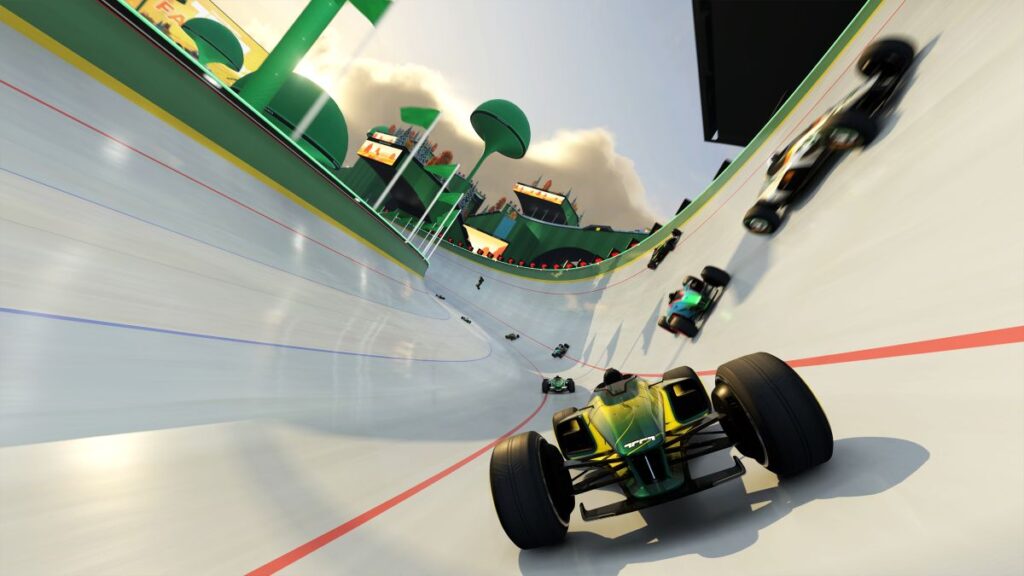
Trackmania’s particular characteristics make that proposition especially interesting. The game occupies an unusual position within racing. It can be competitive and technically demanding, but it is also highly accessible as a spectator product. Its tracks can be created by players, its races are visually straightforward, and its exaggerated mechanics separate it from attempts to reproduce motorsport as faithfully as possible.

That distinction was important to the EF when the organisation started looking for a racing title. Scheuermann told The Esports Radar that the EWC’s game-selection process was partly driven by the need for greater genre diversity. The organisation did not want the programme to become overly concentrated around similar types of games, while racing was an obvious gap.
“We were specifically looking for a title that is racing, sports, and doesn’t necessarily fall into the classic categories that we are already very, very well covering,” Scheuermann said. “That’s rich genre diversity, you could say.”
The search also exposed a question with the racing esports ecosystem itself. Traditional sim racing has a highly dedicated audience, but its competitive proposition does not necessarily translate into broad viewership.
“What we’ve seen is that we are not serving the racing community very well,” Scheuermann explained. “We’ve been looking at the biggest games with the potential to develop esports, because if you look at the overall racing scene, and you could even go into the world of sim racing, it is not a wide audience. It’s super, super niche, and it’s very much not viewership-driven, it’s very much participation-driven.”
The distinction is important: there is undoubtedly an audience for sim racing within esports, and the depth of its competitive communities is one of its strengths. But esports does not necessarily benefit from simply reproducing the experience of watching traditional motorsport. If the proposition is to watch a race that looks and feels almost exactly like a real race, there is already a very well-established product for that.
That was part of the criticism raised in a recent edition of Heat Map discussion and can be applied to RENNSPORT, a title the EWC previously relied on. The simulation can provide a compelling experience for players, but for a spectator who is not already deeply invested in sim racing, there is less differentiation from real-world motorsport. That naturally makes the addressable audience narrower.

Trackmania sits somewhere closer to that other end of the spectrum. It is recognisably a racing game, but it does not attempt to be a digital recreation of Formula 1, GT racing or rallying. Its tracks, physics, competition and presentation give it an identity that belongs specifically to gaming.
“I’m just looking at the hard data,” Scheuermann said. “And so the hard data is that Trackmania is the most watched racing game out there. It has a great scene, it has a great legacy, but what it was missing was an existing ecosystem.”
“Publisher relations and how strongly they’re supporting the game” was another key consideration, according to Scheuermann. That brought the conversation directly to Ubisoft.
“I reached out and said, ‘We need to have a racing game because we saw that in our genre diversity we’re missing out here.’ And so we built a plan together, explored together, and that’s why ultimately you see a result now.”
Deniele described the process from Ubisoft’s side as similarly natural, given the publisher is one of the founding partners of the EWC. “We have a long relationship with them through Rainbow Six,” he said. “We were here from the beginning.”
The timing also made sense for Trackmania itself. According to Deniele, the EWC was assessing which games should enter or leave its programme, while Ubisoft was reaching a point where it believed Trackmania’s competitive ecosystem was mature enough for the opportunity.
“We have created 20 years of Trackmania at a different level, but it was the moment where we said, ‘OK, the community is mature enough to see something across the game on Trackmania and also a way for us to accelerate the growth in other countries.’”
That 20-year evolution stretches back to Trackmania Nations ESWC in 2006, when Ubisoft Nadeo created a version of the game specifically for competitive play and the Electronic Sports World Cup. The title has since developed through major events including WCG, DreamHack and ESL, alongside thousands of community tournaments, before evolving into official circuits such as the Trackmania Grand League, Trackmania World Tour and Trackmania World Cup.
The scene has also attracted an increasingly established network of esports organisations. Solary, Karmine Corp and Berlin International Gaming (BIG) have all fielded Trackmania players, while Team Liquid and Team Falcons entered the scene in 2026, the latest having signed Carl-Antoni “CarlJr” Cloutier, one of the game’s most successful players. CarlJr arrived as a seven-time world champion, following a 2025 World Cup victory with Solary.

Over the years, Trackmania has developed a competitive culture around its unique format, while its club ecosystem has also created another layer of investment around the title. That investment is important because the EWC is not simply adding a game to its programme and expecting the tournament itself to create an ecosystem. Trackmania already has players, teams, clubs and a competitive history. What the EWC potentially adds is another level of visibility and an international stage on which that ecosystem can develop.
“The Trackmania community was legitimately happy that they were included,” Deniele said. “You see a lot of investment in the game from the clubs, exposure in other regions, EMEA is growing a lot on Trackmania right now. So they’re like, ‘Wow, ok, now we are the same size as other games.’”
“It’s difficult in a more niche genre of esports where you are on your own and it’s difficult to bring your audience to get this kind of exposure,” Deniele said.
Its existing European audience can remain the foundation, while the EWC provides an opportunity to introduce the game to audiences in North America, Asia and elsewhere that may have little previous exposure to it.
“We are trying,” Deniele said when asked whether Ubisoft would use the EWC to expand Trackmania scenes elsewhere. “We put some qualifications around the world. It has been a long time since we did it for Trackmania because of the unique circuit of the game.”
Deniele was cautious about what comes next, but clearly sees the EWC as the beginning rather than the conclusion of something for Trackmania.
“We’ll see what’s going on and we are ready, and let’s see where it’s going next time for Trackmania,” he said. “But it’s the beginning of a new era for sure. We have more to announce.”
For the EWC, the addition of Trackmania fills a gap in its programme with a racing title that offers something different from conventional simulation. For Ubisoft, it is a chance to use an increasingly mature competitive ecosystem to reach audiences beyond its traditional markets. And for Trackmania itself, it is an opportunity to move from being a well-established but comparatively niche European esport into a much larger international conversation.