




The Esports Nations Cup (ENC) was supposed to be one of the most interesting new experiments in esports this year. Instead, with only a few months left before its planned November debut in Riyadh, the tournament has been postponed to 2027.
The announcement felt sudden, particularly given how much had already gone into a project built around more than 100 countries competing across 16 esports, with hundreds of coaches appointed and teams and players locked in through qualifiers. The Esports Foundation said the decision followed “ongoing assessment of the wider regional situation, and after consultation with key stakeholders,” and framed the delay as the responsible way to give national teams, publishers, partners and fans the certainty they expect. An undoubtedly fair explanation, but one that has caused upset nonetheless.
Circumstances beyond the Esports Foundation’s control may well be at play, given the aggressive promotion at the Esports World Cup (EWC) 2026 in Paris just weeks earlier. Speculation aside, Heat Map focuses on the facts: The reality is a major international tournament that poured countless hours into building selection pipelines, appointing coaches, securing partners, qualifying players, and announcing a $20 million Development Fund, all targeting a high-stakes November 2026 launch in Riyadh.
Adriano “WOOD7“ Cerato, the Brazilian Counter-Strike veteran, had a comeback letter ready to publish the same morning the news broke. His exit from ODDIK, and a new project built specifically around the chance to represent Brazil at ENC and use a strong result to break into the world’s top 15 via VRS (Valve Regional Standings) ranking points. Instead of an announcement, the letter became something closer to an obituary. “This is the hardest blow I’ve received in my professional life,” he wrote.
Gustavo “Sacy” Rossi, who had expected ENC to be his last major VALORANT tournament, was blunter still: “2027 will be too late for me.” And Team Brazil coach Ian “shaW” Jardim, in an interview with Brazilian journalist Fernando Schwabe, described checking his phone before 8am and assuming at first that the delay was measured in weeks, not a year, before landing on three words for how the day felt: “Only sadness remained”.
That reaction repeated itself across the countries that had already built national programmes around the November date. Japan’s national team manager, Kosuke Hiraiwa, apologised directly to players who had committed their time despite existing pro-league obligations, noting that Japan had already unveiled its national jersey. He also noticed that “an explanatory workshop for national team managers from around the world is scheduled for later in September.”
Great Britain national team organiser Jeff Simpkins admitted the news “hit pretty hard” before adding, a little later, that he’d come around to it: “This is the right decision.” New Zealand Esports Federation CEO Jonathan Jansen struck a similar note, calling the postponement logical given how much traction ENC had generated in a short window, while pushing the Foundation to honour existing player and slot commitments into 2027 rather than reopen qualification from scratch.
Illustrating just how sudden the decision was, commercial rollouts were already actively executing. Global giant adidas was announced as the official outfitter three weeks before the postponement, and had presented the French jersey only two weeks before the delay was communicated publicly.

The ENC is not cancelled. The Foundation says its ecosystem programmes and Development Fund will continue, and the event is now scheduled for Riyadh in November 2027 still planned around 16 titles and a $45 million prize pool. Esports Foundation CEO Ralf Reichert said in a LinkedIn post that qualification alone had participants from over 150 countries across all games combined, calling the decision one that “was not taken lightly.”
“You only get one first edition, and we owe everyone who has put time, energy and belief into ENC the chance to experience it at the level we know it can reach,” Reichert stated.
There’s a strong case that the extra year works in the project’s, and all stakeholders’, favour. The original schedule sat very close to the Esports World Cup (EWC) Paris to allow for a standalone narrative building, and the postponement creates room to grow awareness among audiences well outside core esports fandom.
That matters because national esports competition remains a proposition still to be proven. Initiatives like the Electronic Sports World Cup (ESWC), the IESF World Esports Championships, the Global Esports Games (GEG), and early multi-title events like World Cyber Games (WCG) have all tried some version of country-based competition, but the ENC stands apart from those in both scale and structure, backed by substantial financial resources, extensive publisher support, and the proven expertise and clear ambition of the Esports Foundation.
It’s the first initiative with this level of operational weight to test whether national competition can become a robust driver in esports. 2026 was supposed to be the year we found out. Now everybody will have to wait a little longer to see.
The earlier relocation of the EWC from Riyadh to Paris in May, prompted by the same regional circumstances, gives us the space to dive deeper into what this ENC delay actually means.
While the EWC was successfully rehomed to the French capital, allowing the competition to retain its 2026 dates while avoiding the uncertainty surrounding the Middle East, the ENC was still scheduled to take place in Riyadh later in the year, meaning Saudi Arabia would still have a major international esports event on its calendar.
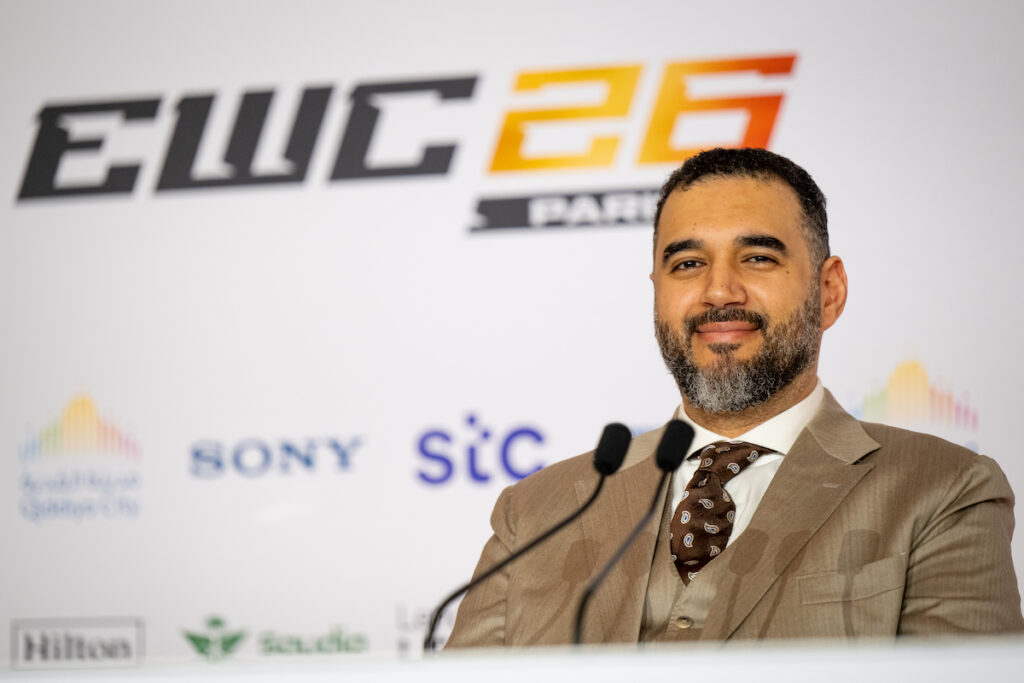
As HRH Prince Faisal bin Bandar bin Sultan told The Esports Radar directly in a 2025 interview, Saudi Arabia’s esports investment sits inside Vision 2030‘s push to diversify the economy and “move away from a dependence on oil and gas.” The objective isn’t simply to drive revenue through esports competitions and gaming, it’s to develop the country nationally and on a global stage.
Relocating the EWC alone might have been acceptable within Saudi Arabia’s broader push for local development and international promotion, but moving both major events abroad is likely to be seen as counterintuitive to that mission, especially given that this is the debut ENC. It’s possible that the Foundation chose to delay the event by a year rather than host it elsewhere.
Two major event disruptions in a single year, upending months of planning, invites the esports industry to a critical reality check — one we’ve touched in a previous Heat Map edition: We cannot take the current influx of Saudi funding for granted, nor should we structure our industry’s ecosystems to depend solely around the Esports Foundation’s events.
That isn’t an argument against the money or the initiative, quite the opposite. Savvy Games Group‘s investment has created opportunities for esports, and the industry should keep using this period to build them. But there’s a distinction between taking advantage of that investment and assuming it will always be there at the same scale.
Esports certainly won’t always sit at the same point on Saudi Arabia’s list of priorities. At some point, the country will hit some of its Vision 2030 objectives; its priorities, the economic environment and the regional situation can all shift, and the money currently flowing into esports could eventually be reduced, repositioned or repurposed.
None of that means Saudi Arabia is leaving esports, there’s zero indication of that in anything the Foundation or Prince Faisal have said, and quite a bit pointing the other way. But it means the industry should treat this funding as an opportunity to build a more robust, more global and more sustainable ecosystem, rather than something it will always need in its current form to function.
The suddenness of the ENC postponement, layered onto the EWC’s relocation and the reactions from the players and federations who’d built their year around November, is a reminder that even the biggest projects in esports can be shaped by circumstances well outside the industry’s control.
For national esports, the postponement means another year in the fridge. For the players and national partners who committed their planning to this window, the delay is a frustrating and costly setback. For the broader industry, this is a crucial heads up.
This analysis was first published in the Heat Map newsletter on 02 September 2026. For early access to our analysis and more exclusive content, subscribe to The Esports Radar’s newsletters via this link.