



One report over the past couple of weeks really caught the industry’s attention. HLTV published a deep dive into how Valve’s changes to Counter-Strike (CS) Major stickers, which initially aimed at rewarding organisations that achieve a long run in the competition, have affected organisations’ finances. Some of the figures were genuinely startling: According to the report, some mid-tier teams saw their sticker revenue fall from around $600,000 to roughly $120,000, an 80% drop from one Major to the next.
Those are eye-catching numbers on their own, but what mainly captured my attention was what those missing dollars can tell us about the future of competitive Counter-Strike and, perhaps, of esports as a whole.
For years, qualifying for a CS Major wasn’t just about prestige, it could completely transform an organisation’s finances. Sticker revenue often paid for months of operations, justified investments in players and staff, and even allowed organisations to take chances in other esports titles. It was one of those moments where a team outside the very top could suddenly receive a financial boost big enough to change its trajectory.
HLTV’s report points to SINNERS as an example. According to Co-founder Moritz “Askadar” Straube, qualifying for the Major was expected to finally make years of investment pay off and allow the organisation to scale. With the new sticker system, that expectation changed almost overnight. Organisations sitting in esports’ middle tier suddenly have much less room for error. Another example, Gaimin Gladiators halted its Counter-Strike 2 (CS2) project entirely.

The consequences are easy to imagine. Teams will surely rely even more on revenue from circuits run by ESL FACEIT Group, BLAST and PGL, all of which have committed to investing heavily in their ecosystems. Qualifying for a Major is still hugely important, but perhaps not in the same game-changing way it used to be. Organisations may become more conservative when investing in Counter-Strike, or more hesitant, and player contracts will likely evolve alongside this new reality. Even with the ban on skin trading websites, overall dependence on sponsorships may still increase, whilst projects in other esports could lose one of the funding sources that previously helped keep them alive.
Last week, we published an interview with G2 Esports CEO Alban Dechelotte, and there was one quote that immediately came back to mind while reading HLTV’s report:
“A few years ago, when I was working for Riot, there were roughly 300 teams globally competing. Nowadays, across the big games, there are fewer than 100. In the next five years, you will have roughly 20 teams that dominate globally across all major games. You will still have five to ten local teams per region specialised in one game. Everything in between will suffer.”
A few days later, Dechelotte’s statement already feels like it’s hitting home even sooner.
What the sticker changes actually do is accelerate exactly the trend that Dechelotte was describing. The organisations that sit in the middle; those big and bold enough to dream globally, but not quite big enough to enjoy the financial muscle of the Falcons, Vitality’s, NAVI’s or G2’s of the world, just lost one of their most valuable revenue streams related to competitive success in CS.
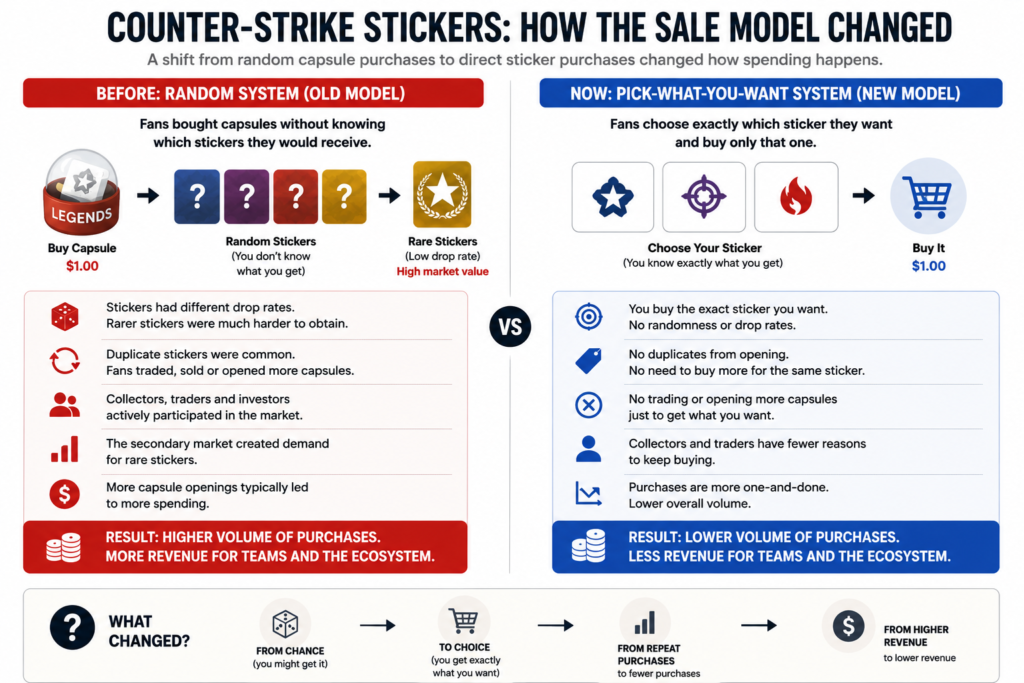
Valve has been steadily moving away from gambling-related mechanics in its ecosystem. Towards the end of last year, it banned the promotion of skin gambling, case-opening and skin trading websites at officially licensed tournaments using its games, which also happens to compromise a sponsorship channel frequently relied on by Tier-2 organisations. More recently, it also changed the sticker system from a luck-based case-opening mechanic to simply allowing people to buy exactly the sticker they want.
The previous sticker system resembled the economics of collecting Panini World Cup sticker packs. Fans bought capsules without knowing which stickers they would receive, encouraging repeat purchases in pursuit of rarer items or missing pieces. The new model removes that uncertainty entirely. It is a far more transparent consumer experience, but one that naturally generates fewer repeat purchases and, consequently, less revenue flowing into the ecosystem.
Reasons behind these actions can be linked to the increasing legal pressure Valve has been facing around the world over lootbox mechanics that can resemble gambling. In the U.S., New York Attorney General Letitia James has filed a lawsuit against Valve in early 2026, accusing the company of promoting illegal gambling through games played not only by adults, but by children and teenagers. In Brazil in June 2026, Valve was hit with a BRL $10 million (approximately USD $2 million) fine for the same practices.
Looking through that lens, the sticker changes start feeling less like an isolated business decision and more like another step as a part of a broader strategy. The issue is that, like many decisions in esports, the side effects don’t impact everyone equally.
The biggest organisations will probably have the necessary structure to navigate these new waters. They have diversified revenue, huge fanbases and commercial partners that go far beyond Counter-Strike. Alongside these, more localised organisations like Red Canids in Brazil, FENNEL in Japan, or CGN Esports in Germany can still build sustainable businesses around local ecosystems.
It is the organisations caught in the middle that face the biggest challenge: teams like GamerLegion, capable of and focused on competing on the global stage but without the commercial scale of the industry’s biggest brands. As traditional revenue opportunities become scarcer, it would not be surprising to see more of these organisations looking towards sectors still willing to invest heavily in esports, such as iGaming. OG Esports with Dexsport and Imperial Esports, currently branded as Gamdom Imperial following its iGaming naming-rights partnership, are two examples of that trend.
Maybe that’s why G2 CEO Dechelotte’s comments resonated so much with the moment. They didn’t feel like a prediction anymore, they feel like an explanation of what we’re already watching happen.
For all effects, Valve is also attempting to refine the model and step up results before the end of the sales period. On July 28, the company introduced the new Cologne 2026 Ranked Series stickers and acknowledged that its previous dynamic pricing system “didn’t produce reasonable prices”: products previously valued at 150,000 tokens (roughly $1,500) are now available for $60. The adjustment suggests that the sticker economy remains a live experiment, while keeping the 50% revenue share for teams, players and the tournament organiser unchanged.
Therefore, this week’s Heat Map points to warm temperatures at the very top of the CS pyramid, where the biggest organisations continue pulling away from the rest. The bottom stays relatively cool, with opportunities to heat up through regional ecosystems and player development. The cold front is sitting firmly in the middle, and after these sticker changes, it feels like the winds have only gotten stronger.
Editor’s Note: Given the time-sensitive nature of this topic, we are making an exception and publishing today’s Heat Map on The Esports Radar the same day it lands in inboxes. Normally, Heat Map subscribers enjoy exclusive early access to our deep dives long before they hit the site. To receive our breaking analysis the moment it drops, subscribe to our newsletters here.

Follow The Esports Radar on social media: